
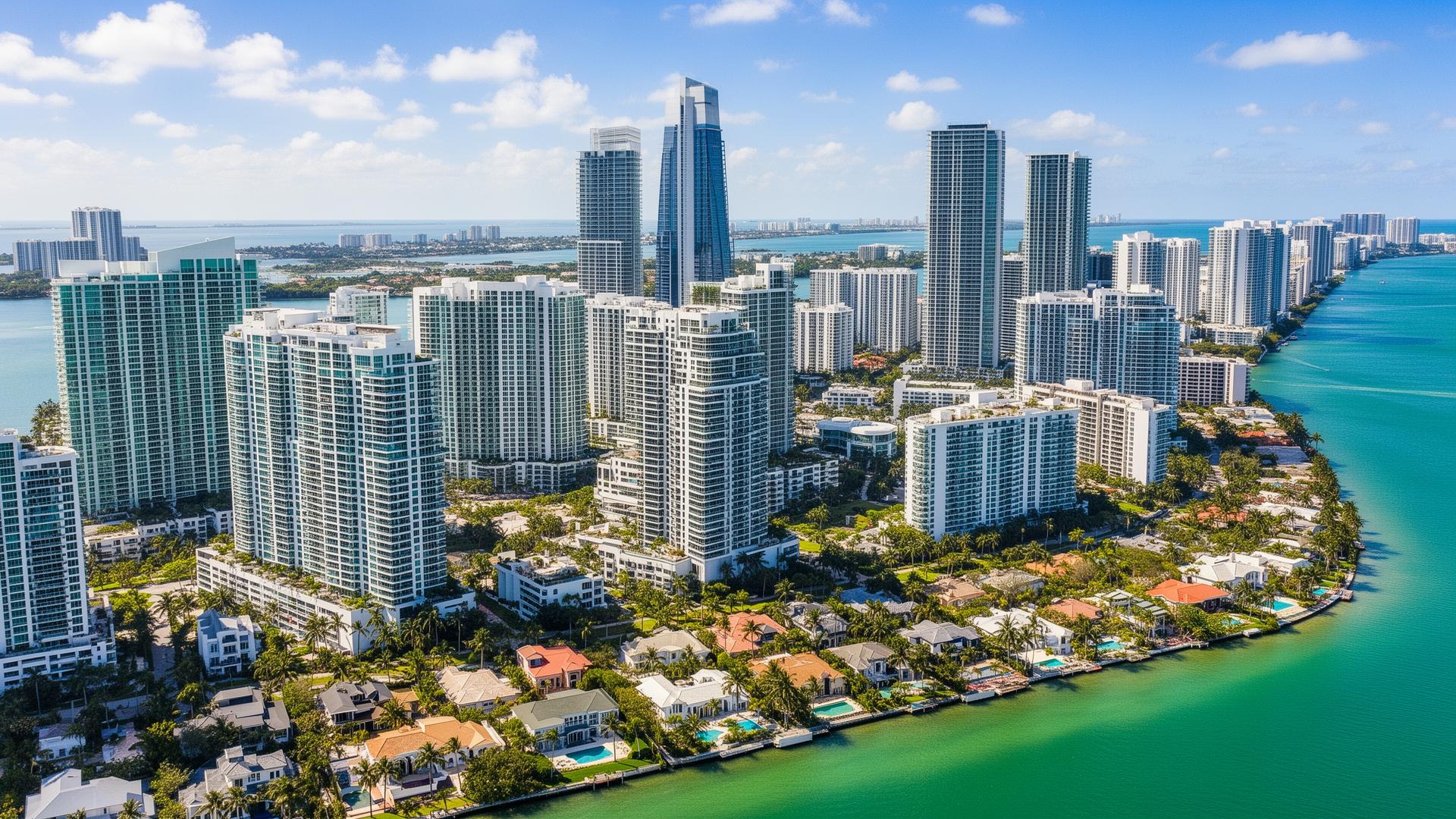
Relocating to South Florida in 2026: A Buyer's Guide
If you are relocating to South Florida in 2026, the practical questions come down to four things: what you will pay in taxes, what homes actually cost right now, what it costs to insure them, and how the property tax system treats you once you become a resident. The short version is that Florida charges no individual income tax, and the Tax Foundation ranks the state 5th overall on its 2026 State Tax Competitiveness Index [1]. Home prices in Miami-Dade have cooled from the early-2020s run-up, with the single-family median around $660,000 and condos near $406,000 as of mid-2025 [2]. Insurance, long the hardest part of the math, is showing its first relief in years, with Citizens Property Insurance reducing rates roughly 14% in Miami-Dade at Spring 2026 renewals [3]. And once you make a Florida home your permanent residence, the homestead exemption and the Save Our Homes cap put a ceiling on how fast your assessed value can rise [4].
Last updated: June 2026
This guide walks through each of those numbers and what they mean for a relocation budget, then covers neighborhood fit, the buying process, and the questions buyers ask most.
The tax picture: no state income tax, but verify the full bill
Florida is one of a handful of states with no individual income tax, and that remains true in 2026. The Tax Foundation places Florida 5th overall on its 2026 State Tax Competitiveness Index, and the state has no individual income tax line at all [1]. For someone moving from a high-tax state, the difference in take-home income can be meaningful, but it is not the whole story.
Florida funds itself through other channels: a 6% state sales tax and property taxes that together make up the bulk of state and local revenue [1]. The effective property tax rate on owner-occupied housing runs around 0.78% of value [1]. When you underwrite a move, model the property tax and insurance line alongside the income tax savings rather than treating the no-income-tax status as a standalone win. Residency also has rules. To claim Florida as your domicile you generally need to actually live here and establish the usual markers of permanent residence, which is also what unlocks the homestead benefits discussed below.
What homes cost in Miami-Dade right now
The market that relocators are entering in 2026 looks different from the one that made headlines a few years ago. According to MIAMI REALTORS data, the single-family median price in Miami-Dade was about $660,000 in mid-2025, a slight year-over-year decline of roughly 1.5%, with about 6.6 months of supply, which is a balanced market [2]. The condo segment is softer: a median around $406,000, down about 4.5% year over year, with months of supply near 14, which favors buyers [2].
The split matters. Single-family inventory is closer to equilibrium, so well-priced houses in desirable areas still move. Condos, especially older buildings, carry more negotiating room, partly because some buildings face financing and reserve-funding constraints that narrow the buyer pool. If you are weighing a house against a condo, the underwriting questions are different: for a house, focus on insurance and roof age; for a condo, scrutinize the building's reserves, assessments, and lender approval status before you fall for the view.
Neighborhood choice drives a lot of this. Brickell is the dense, walkable urban core favored by buyers who want a lock-and-leave condo near the financial district. Coral Gables offers tree-lined streets, single-family homes, and a more residential pace. Both sit at very different price points and lifestyles, and the right fit depends on whether you are buying a primary home, a part-time base, or an investment.
Insurance: the line item that finally moved
For several years, property insurance was the single biggest surprise in a Florida relocation budget. That pressure is easing. Citizens Property Insurance, the state-backed insurer, proposed its first statewide rate decrease in roughly a decade, and after regulatory review the reductions reach about 14% in Miami-Dade and Broward at renewals beginning in Spring 2026 [3]. More private carriers have re-entered the market as well, which is what creates competition on price.
That said, insurance in coastal South Florida is still a major cost, and premiums vary widely by the home's age, elevation, roof, and flood zone. Newer construction built to current codes, with impact-rated windows and a recent roof, typically prices better and is easier to insure. Before you write an offer, get an insurance quote on the specific property. A house that looks affordable on the list price can carry a premium that changes the monthly number substantially, and that is exactly the kind of figure to confirm during due diligence.
Homestead exemption and the Save Our Homes cap
Once a Florida home is your permanent residence, two benefits change your long-term carrying cost. The homestead exemption removes up to $50,000 from your home's assessed value for tax purposes: the first $25,000 applies to all taxing authorities, and a second $25,000 applies to non-school taxes on assessed values above $50,000 [4]. You must own and occupy the home as your permanent residence and file by the March 1 deadline [4].
The larger long-term benefit is Save Our Homes, which caps the annual increase in your homestead's assessed value at 3% or the change in the Consumer Price Index, whichever is lower [4]. In practice that means once you establish homestead, your taxable value cannot jump with the market, which makes your future tax bill far more predictable. For a long-term relocation this is one of the more valuable, and most overlooked, parts of the move.
Building a relocation plan
A South Florida move is part real estate transaction and part logistics. A workable sequence looks like this:
- Set the budget using the full carrying cost: price, property tax at the local millage, an actual insurance quote, and any condo or community fees.
- Decide on residency timing so you can file for homestead by the March 1 deadline and start the Save Our Homes clock.
- Narrow neighborhoods to two or three that fit your daily routine, commute, and home type before touring.
- Line up financing early, and for condos confirm the building is warrantable for your loan type before you commit.
If you want help mapping price points, neighborhoods, and the tax and insurance math to your situation, a buyer consultation is the place to start. You can also review answers to common questions on the FAQ page.
Frequently asked questions
Does Florida really have no state income tax in 2026?
Yes. Florida has no individual income tax, and the Tax Foundation ranks the state 5th overall on its 2026 State Tax Competitiveness Index [1]. The state instead relies on sales and property taxes, so build those into your budget rather than counting only the income tax savings.
What does a home cost in Miami-Dade in 2026?
As of mid-2025, MIAMI REALTORS reported a single-family median around $660,000 and a condo median around $406,000, with single-family supply near balanced and condos in buyer-favorable territory [2]. Prices vary widely by neighborhood and property type, so treat the median as a starting reference.
Is Florida home insurance still rising?
Not uniformly. Citizens Property Insurance approved its first rate decrease in about a decade, with reductions reaching roughly 14% in Miami-Dade and Broward at Spring 2026 renewals, and more private carriers have re-entered the market [3]. Costs remain significant in coastal areas, so always quote the specific property.
What is the homestead exemption and Save Our Homes cap?
The homestead exemption removes up to $50,000 of assessed value once a Florida home is your permanent residence, and Save Our Homes caps annual assessed-value increases at 3% or CPI, whichever is lower [4]. You must file by March 1 to claim it.
Should I buy a single-family home or a condo?
It depends on the underwriting. Houses carry insurance and maintenance considerations; condos require checking the building's reserves, assessments, and lender approval status. The condo market currently offers more negotiating room, while well-priced single-family homes remain competitive.
Gabriel
Sources
- Tax Foundation: Florida Tax Rates and Rankings (2026 State Tax Competitiveness Index)
- MIAMI REALTORS / Norada Real Estate: Miami Housing Market Trends and Forecast 2025-2026
- Insurance Journal: Florida's Citizens Now Wants HO Rate Decrease
- Miami-Dade County Property Appraiser: Homestead Exemption and Save Our Homes
Gabriel A. Moyers, PA. eXp Realty. Florida License #3407280. Equal Housing Opportunity. This article is general information as of June 2026 and is not legal, tax, or financial advice. Verify current figures against authoritative sources before acting.
Thinking of selling your luxury property in Miami? Find out what your home is worth.
Get Your Home ValuationLooking for your dream home in Miami? Take our personalized home search quiz.
Start Your Home Search Quiz