
Coconut Grove vs. Coral Gables: A Buyer's Comparison
Last updated: June 2026
If you are weighing Coconut Grove vs Coral Gables, the short answer is that they solve for different buyers. Coconut Grove is Miami's oldest continuously inhabited neighborhood, with a waterfront, walkable, village character along Biscayne Bay [1]. Coral Gables is a planned city incorporated in 1925, built in a consistent Mediterranean Revival style with wide, tree-lined avenues and stricter design controls [2]. On price, the two have diverged recently. Over the three months ending around March 2026, the median sale price in Coconut Grove was about $2.6 million, while Coral Gables sat near $1.3 million [3][4]. Per-square-foot, the Grove ran roughly $909 against the Gables at about $709 [3][4]. So the Grove tends to carry a waterfront and walkability premium, and the Gables tends to give you more interior square footage and a more uniform streetscape for the dollar.
This is a comparison of character, pricing, and the underwriting trade-offs between the two, not a ranking. The right pick depends on whether you are paying for proximity to the bay or for predictability and lot size. If you want a current read on a specific home or block, a listing valuation is the better tool than any neighborhood average.
How the two neighborhoods differ in character
Coconut Grove
Coconut Grove sits directly on Biscayne Bay, and that border defines the lifestyle. The neighborhood is home to the Coconut Grove Sailing Club, the Biscayne Bay Yacht Club, and Dinner Key Marina, with a long boating and sailing culture [1]. It is also Miami's oldest continuously inhabited neighborhood, settled in the 19th century and annexed by the City of Miami in 1925 [1]. The built environment is less uniform than the Gables. You will find historic wood-frame homes, mid-century houses, newer luxury construction, and a dense, walkable core of dining and retail around the village center. For a buyer, that variety means wider pricing and condition ranges on the same street, which is why a block-level read matters more here.
Coral Gables
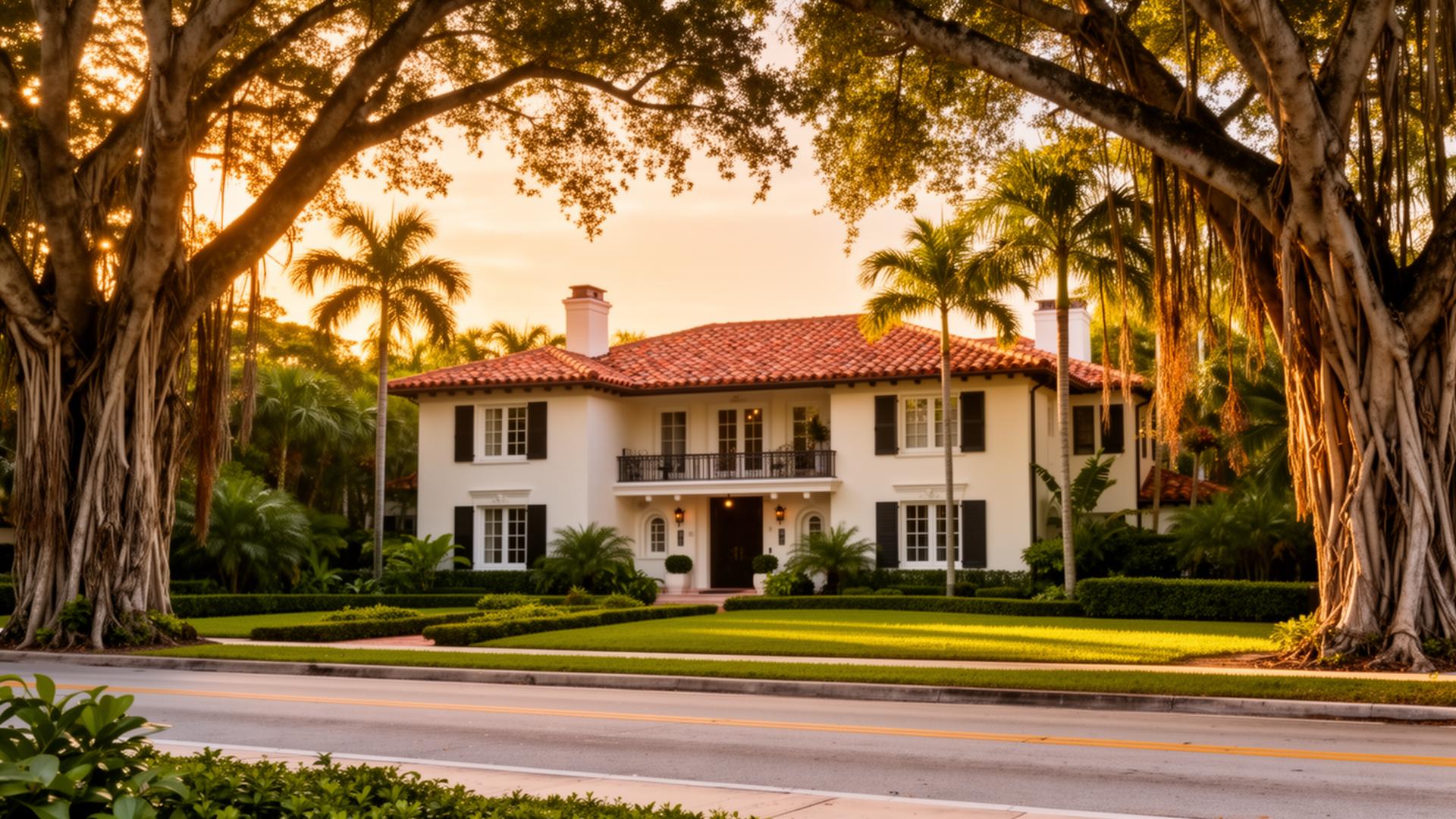
Coral Gables was planned and developed by George Merrick in the 1920s as one of the first major planned communities in the United States, and it was incorporated on April 29, 1925 [2]. Merrick built it in the Mediterranean Revival style, with Spanish street names like Granada, Alhambra Circle, and Castile, plazas, and grand entrances [2]. The City Beautiful planning still governs the streetscape today, and the city maintains design controls that keep the look consistent [2]. For a buyer, that consistency cuts both ways. You get predictability and curb-appeal protection from your neighbors, and you also accept a more involved approval process for exterior changes and renovations.
Price and value, as of early 2026
Pricing is where the two neighborhoods separate clearly right now, and the gap is worth underwriting carefully because it has moved fast.
- Coconut Grove: median sale price around $2.6 million over the three months ending near March 2026, up roughly 53% year over year, at about $909 per square foot [3].
- Coral Gables: median sale price around $1.3 million as of early 2026, down roughly 27% year over year, at about $709 per square foot [4].
Two cautions on those figures. First, both are small, segmented markets, so a few high-end or low-end closings swing the median hard. The large year-over-year moves in opposite directions are a sign of mix shift (which homes happened to sell), not necessarily a clean read on what any one home is worth. Second, a neighborhood median tells you almost nothing about a specific waterfront lot versus an interior teardown. Treat these as orientation, not as a valuation. For an actual number on a home you are considering, start with a buyer consultation so the comps match the property, not the zip code.
What the price gap is actually paying for
The Grove premium is largely a location and walkability premium: bay proximity, marina access, and a compact village core you can live in without a car for daily errands. The Gables, at a lower median and lower price per square foot in this window, tends to deliver more interior square footage, larger and more uniform lots, and a protected architectural setting. Neither is "cheaper" in a vacuum. They are priced for different things.
Carrying costs and what to underwrite
Headline price is only the entry point. In both neighborhoods, the recurring costs deserve as much attention as the purchase price.
- Property taxes. Miami-Dade assesses and taxes both areas, and your tax bill resets toward market value after a sale rather than carrying over the seller's capped assessment. Always model the post-sale tax bill, not the seller's current one. Verify any specific parcel against the Miami-Dade County Property Appraiser before you write an offer [5].
- Insurance. Florida property insurance, including wind and, for waterfront or low-lying parcels, flood coverage, is a material line item and has been volatile statewide. Get a real quote for the specific address early in diligence rather than estimating [6].
- Renovation and approvals. Coral Gables design review and its historic protections can lengthen and constrain exterior projects. In the Grove, age and variety of housing stock mean condition and systems vary widely. Both argue for a thorough inspection and, where relevant, a permit-history check.
If you are coming from the sell side and trying to fund a move between these two, the home sale page walks through how net proceeds and timing interact.
Which one fits which buyer
Use this as a starting filter, then test it against actual listings.
- Lean Coconut Grove if you want to be on or near the water, value a walkable village core, and accept a higher median and more variable housing stock for that location.
- Lean Coral Gables if you want more interior square footage and lot size for the dollar in this window, prefer a uniform, design-controlled streetscape, and do not need to be directly on the bay.
- Look at both if your priority is a specific home rather than a vibe. The medians overlap enough at the property level that the right house can show up in either place.
You can browse current inventory on the Miami luxury homes page to pressure-test these generalizations against live listings.
Frequently asked questions
Is Coconut Grove more expensive than Coral Gables?
In the window ending around March 2026, yes. Coconut Grove's median sale price was about $2.6 million versus roughly $1.3 million in Coral Gables, and the Grove also ran higher per square foot, about $909 to $709 [3][4]. These are small markets, though, so the gap reflects which homes sold as much as underlying value. Confirm with current comps for any specific property.
Which neighborhood is better for boating and waterfront living?
Coconut Grove. It borders Biscayne Bay directly and includes the Coconut Grove Sailing Club, the Biscayne Bay Yacht Club, and Dinner Key Marina, with an established boating community [1]. Coral Gables has waterfront sections too, but the Grove's identity is more tied to the bay.
Why does Coral Gables have stricter rules on home design?
Coral Gables was planned as a unified Mediterranean Revival city by George Merrick in the 1920s and incorporated in 1925 [2]. The city has maintained design controls and historic protections to preserve that look, which is why exterior renovations there can involve more review than in many Miami neighborhoods [2].
How current are these price figures?
The medians cited here are drawn from Redfin neighborhood and city data reflecting sales through roughly March 2026 [3][4]. Real estate figures move quarterly and both areas are small markets, so treat them as a snapshot. For a current, property-specific number, request a listing valuation.
Working through the decision
There is no single right answer between these two. The Grove tends to price for water and walkability, the Gables for space and a controlled streetscape, and the medians shift enough quarter to quarter that the better move is to look at real homes in both. If you want help running the numbers on a specific property, including post-sale taxes and insurance, reach out and we can underwrite it together.
Gabriel
Sources
- Wikipedia, "Coconut Grove" — https://en.wikipedia.org/wiki/Coconut_Grove
- Wikipedia, "George E. Merrick" — https://en.wikipedia.org/wiki/George_E._Merrick
- Redfin, "Coconut Grove, Miami Housing Market" — https://www.redfin.com/neighborhood/219259/FL/Miami/Coconut-Grove/housing-market
- Redfin, "Coral Gables Housing Market" — https://www.redfin.com/city/3707/FL/Coral-Gables/housing-market
- Miami-Dade County Property Appraiser — https://www.miamidade.gov/pa/
- Florida Office of Insurance Regulation, homeowners insurance resources — https://www.floir.com/
Gabriel A. Moyers, PA. eXp Realty. Florida License #3407280. Equal Housing Opportunity. This article is general information as of June 2026 and is not legal, tax, or financial advice. Verify current figures against the Miami-Dade County Property Appraiser and current Redfin or MLS market data before acting.
Thinking of selling your luxury property in Miami? Find out what your home is worth.
Get Your Home ValuationLooking for your dream home in Miami? Take our personalized home search quiz.
Start Your Home Search Quiz