
Historic Homes in Coconut Grove: Architecture, Designation, and What Buyers Should Know
Last updated: June 2026
Historic homes in Coconut Grove range from late-1800s bay-front cottages to 1920s Mediterranean Revival estates, set in Miami's oldest continuously inhabited neighborhood. Coconut Grove was settled in the 1870s, predating the City of Miami's 1896 incorporation [1]. For a buyer, the appeal is the architecture and the tree canopy, but the underwriting question is narrower: is the home individually designated or inside a historic district, because that determines whether exterior changes need city review before a permit can be issued [2].
Here is the short version. A home that carries a local historic designation, or sits as a contributing building in a designated district, requires a Certificate of Appropriateness (COA) from the City of Miami before exterior work proceeds [2]. That is a process, not a prohibition: most COAs are approved administratively within a few days, and larger projects take longer [2]. In exchange, owners of qualified historic properties may be eligible for a Florida ad valorem tax exemption covering up to 100% of the increase in assessed value from an approved rehabilitation, for up to 10 years [3]. So designation is a constraint on the renovation timeline and a potential offset on the tax side. Both belong in the math before you write an offer.
Pricing reflects scarcity. The median sale price in Coconut Grove was about $2.6 million over the trailing three months, up roughly 53% year over year, with homes taking around 88 days to sell as of June 2026 [4]. That spread between a high median and a slow pace tells you the market rewards specific, well-positioned inventory rather than moving everything quickly.
What "historic" actually means here
Coconut Grove is the oldest continuously inhabited neighborhood in Miami-Dade County, founded in 1873 [1]. Its anchor is The Barnacle, the home Commodore Ralph Middleton Munroe built in 1891, which the state describes as the oldest house in Miami-Dade County still standing in its original location [5]. That depth of history is why the neighborhood carries so many designated structures and district overlays.
"Historic" is a legal status, not a vibe. A property earns it one of three ways under Florida's framework: individual listing in the National Register of Historic Places, status as a contributing building within a National Register district, or designation under a local preservation ordinance [3]. Each path carries the same practical consequence for an owner who wants to alter the exterior, which is municipal review.
The architecture you will actually see
Coconut Grove's housing stock is genuinely mixed, which is part of why two homes a block apart can price very differently.
Mediterranean Revival
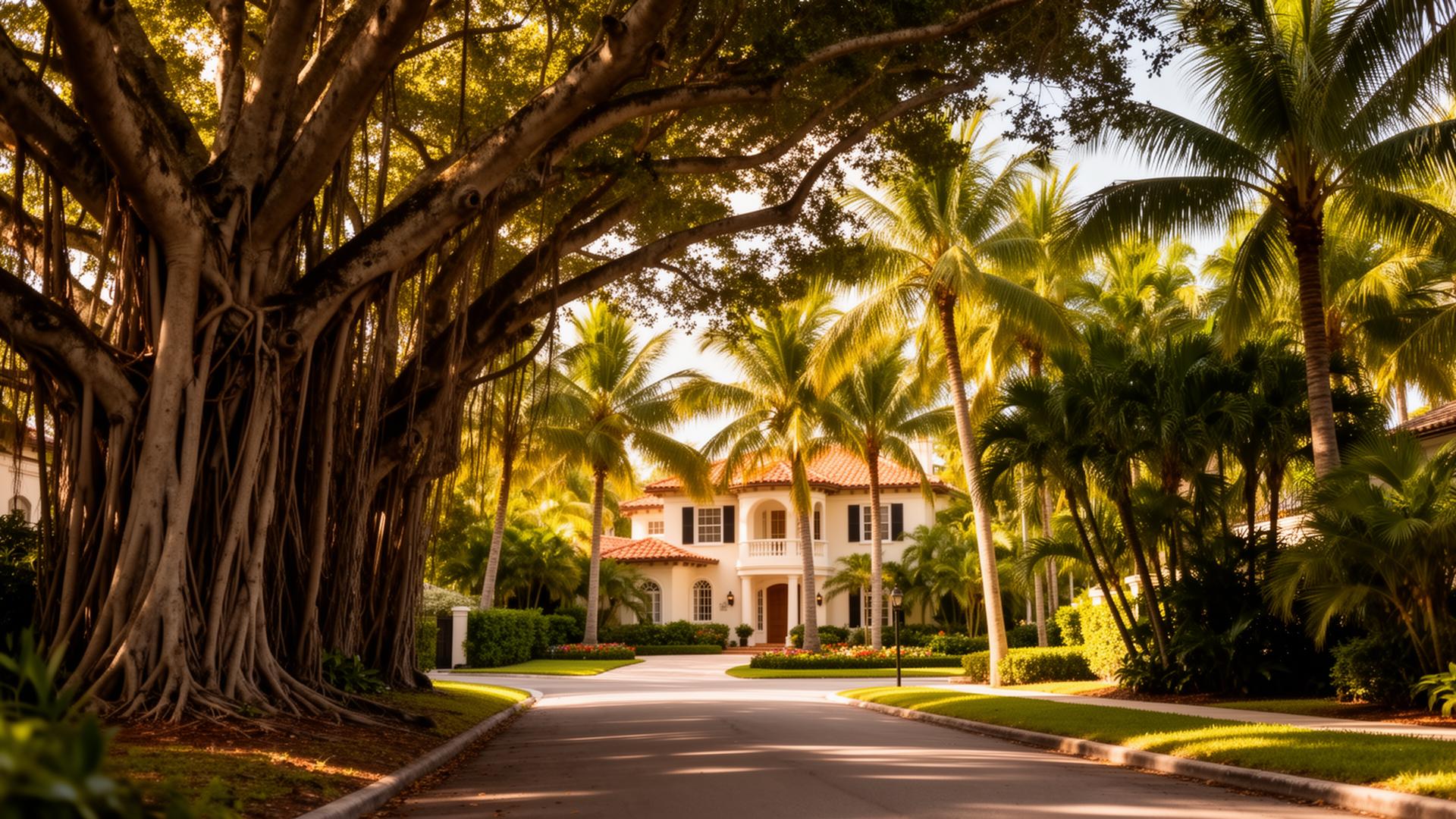
The dominant historic style, set in the 1920s land-boom era. Stucco walls, barrel-tile roofs, arched openings, and courtyards. The Coconut Grove Playhouse, a 1927 Mediterranean Revival theater, is the neighborhood's best-known example and is listed on the National Register for its architecture [6].
Early frame cottages and bungalows
The oldest layer, predating the 1920s boom. The Barnacle began as a one-story bungalow raised on wood pilings in 1891, then was lifted to insert a new ground floor in 1908 as the family grew [5]. Surviving cottages of this era are small in footprint and tightly held.
Mid-century and tropical modernism
Postwar homes that lean into cross-ventilation, deep overhangs, and indoor-outdoor flow suited to the climate. These are often not designated, which gives a renovator more freedom than a Mediterranean Revival contributing structure would.
Contemporary estate construction
New and recently rebuilt homes, frequently on the larger bay-adjacent lots, where the value sits in the land and the waterfront access rather than in any protected fabric.
If you are weighing styles against your own plans, my buyer consultation walks through which designation status fits which renovation appetite.
The designation question, framed as underwriting
Treat designation like any other entitlement issue. It does not make a home a bad buy. It changes the cost and the calendar of changing the home.
What designation requires
For a designated property or a contributing building in a district, exterior changes must be reviewed and approved before a building permit issues, through a Certificate of Appropriateness [2]. Routine COAs are often approved administratively within a day or two; extensive plans take longer [2]. Interior-only work and ordinary maintenance generally carry far less friction, but confirm scope with the city's historic preservation office before assuming.
What designation can return
Florida Statute 196.1997 lets local governments exempt up to 100% of the increase in assessed value created by an approved rehabilitation, for as long as 10 years [3]. The work has to follow the Secretary of the Interior's Standards for Rehabilitation, and the property has to be a qualified historic property [3]. In plain terms: a sensitive, approved restoration can raise the home's value without that improvement raising your tax bill for a decade. That is a real number to put against the COA timeline.
How to price the constraint
The practical move is to underwrite two paths before you offer. Path one is the home as-is, with no exterior changes. Path two is your intended renovation, with the COA review timeline built into your carry costs and the potential tax exemption built into your hold. The gap between those two paths is what you are actually buying. If you want that modeled against comparable sales, the listing valuation request is the fastest way to start.
What current pricing tells you
As of June 2026, Coconut Grove's median sale price sat near $2.6 million over the trailing three months, up about 53% from the prior year, with a median of roughly 88 days on market [4]. Read those two figures together. A sharp year-over-year median increase paired with a near-three-month selling pace is not a fast-flip market. It is a market where correctly positioned, well-documented homes (and designated historic homes are, by definition, well-documented) clear, while generic inventory lingers.
For a seller of a historic Grove home, that argues for leaning into the documentation: the designation file, the prior COA approvals, any rehabilitation tax exemption already in place. Those reduce a buyer's uncertainty, and reduced uncertainty is what shortens days on market. If you are preparing to list, selling your Miami home starts with assembling exactly that file.
Frequently asked questions
Can I renovate a historic home in Coconut Grove?
Yes. If the home is individually designated or a contributing building in a historic district, exterior changes need a Certificate of Appropriateness from the City of Miami before a building permit can issue, and most are approved administratively within a few days [2]. Interior and maintenance work generally faces less review. Confirm scope with the city before planning.
Are there tax benefits to owning a historic home in Florida?
There can be. Under Florida Statute 196.1997, local governments may exempt up to 100% of the increase in assessed value from an approved rehabilitation of a qualified historic property, for up to 10 years, if the work meets the Secretary of the Interior's Standards [3]. Eligibility and adoption vary by jurisdiction, so verify locally.
How old is Coconut Grove?
It is Miami's oldest continuously inhabited neighborhood, founded in 1873, before the City of Miami incorporated in 1896 [1]. The Barnacle, built in 1891, is described by the state as the oldest house in Miami-Dade County still on its original site [5].
What does a historic home in Coconut Grove cost?
The Coconut Grove median sale price was about $2.6 million over the trailing three months as of June 2026, up roughly 53% year over year, with a median near 88 days on market [4]. Designated historic homes vary widely by lot, condition, and waterfront access, so treat the median as a starting reference, not a quote.
Does historic designation lower a home's value?
Not inherently. Designation constrains exterior changes and adds a review step, but it also brings a potential decade-long rehabilitation tax exemption [3] and a documented provenance that can reduce buyer uncertainty in a market selling near 88 days on market [4]. The right question is how designation interacts with your specific renovation plans, not whether it is good or bad in the abstract.
Working the numbers before you offer
Historic homes in Coconut Grove reward buyers who treat designation as a line item rather than a surprise. Model the home as-is and the home renovated, put the COA timeline and the possible tax exemption on the same page, and compare against recent sales. If you want help building that comparison for a specific address, you can reach me through the contact options on the site or browse current Miami luxury homes for sale.
Gabriel
Sources
- Wikipedia, "Coconut Grove" — https://en.wikipedia.org/wiki/Coconut_Grove
- City of Miami, "Get a Standard Certificate of Appropriateness (COA)" — https://www.miami.gov/Permits-Construction/Historically-Designated-Properties/Get-a-Standard-Certificate-of-Appropriateness-COA
- Florida Department of State, Division of Historical Resources, "Property Tax Exemption for Historic Properties (s. 196.1997, F.S.)" — https://dos.fl.gov/historical/preservation/architectural-preservation-services/property-tax-exemption-for-historic-properties/
- Redfin, "Coconut Grove, Miami Housing Market" — https://www.redfin.com/neighborhood/219259/FL/Miami/Coconut-Grove/housing-market
- Florida State Parks, "History of the Barnacle / The Barnacle Historic State Park" — https://www.floridastateparks.org/learn/history-barnacle
- Florida Department of State, "Secretary Detzner Announces the Designation of Two Miami Landmarks on the National Register of Historic Places" — https://dos.fl.gov/communications/press-releases/2018/secretary-detzner-announces-the-designation-of-two-miami-landmarks-on-the-national-register-of-historic-places/
Gabriel A. Moyers, PA. eXp Realty. Florida License #3407280. Equal Housing Opportunity. This article is general information as of June 2026 and is not legal, tax, or financial advice. Verify current figures against the City of Miami Office of Historic Preservation and the Florida Division of Historical Resources before acting.
Thinking of selling your luxury property in Miami? Find out what your home is worth.
Get Your Home ValuationLooking for your dream home in Miami? Take our personalized home search quiz.
Start Your Home Search Quiz