
Coconut Grove Walkability and Luxury Real Estate: A Buyer's Guide
Last updated: June 2026
Coconut Grove walkability is the feature that separates this neighborhood from most of luxury Miami. The 33133 area carries a Walk Score of 94, a rating the index labels a "Walker's Paradise" where daily errands do not require a car [1]. That number sits next to a luxury housing market: the median sale price across Coconut Grove was about $2.6 million over the three months ending in spring 2026, up roughly 52.7% year over year, with homes taking around 87.5 days to sell [2]. So the underwriting question for a buyer is straightforward. You are paying a luxury price, and part of what you are paying for is a walkable village core wrapped in a single-family, tree-canopy neighborhood, which is a combination that is hard to replicate elsewhere in the metro.
This guide covers what the walkability score actually measures, how the village center is laid out, what the price and time-on-market data say about negotiating position, and the carrying-cost items (insurance, flood, taxes) that belong in any Grove analysis. If you want a property-specific read, a buyer consultation is the faster path, and current inventory is on the Miami luxury homes for sale page.
What the Walk Score actually measures
Walk Score rates a location from 0 to 100 based on walking distance to amenities like groceries, restaurants, schools, and parks, with shorter routes scoring higher. Coconut Grove's central 33133 area scores 94, in the "Walker's Paradise" band, alongside a Transit Score of 51 ("Good Transit") and a Bike Score of 85 ("Very Bikeable") [1].
A few practical notes on reading that number:
- The score is geographic, not per-listing. A home in the heart of the village walks very differently from one on the residential edges, so the headline 94 describes the core, not every address.
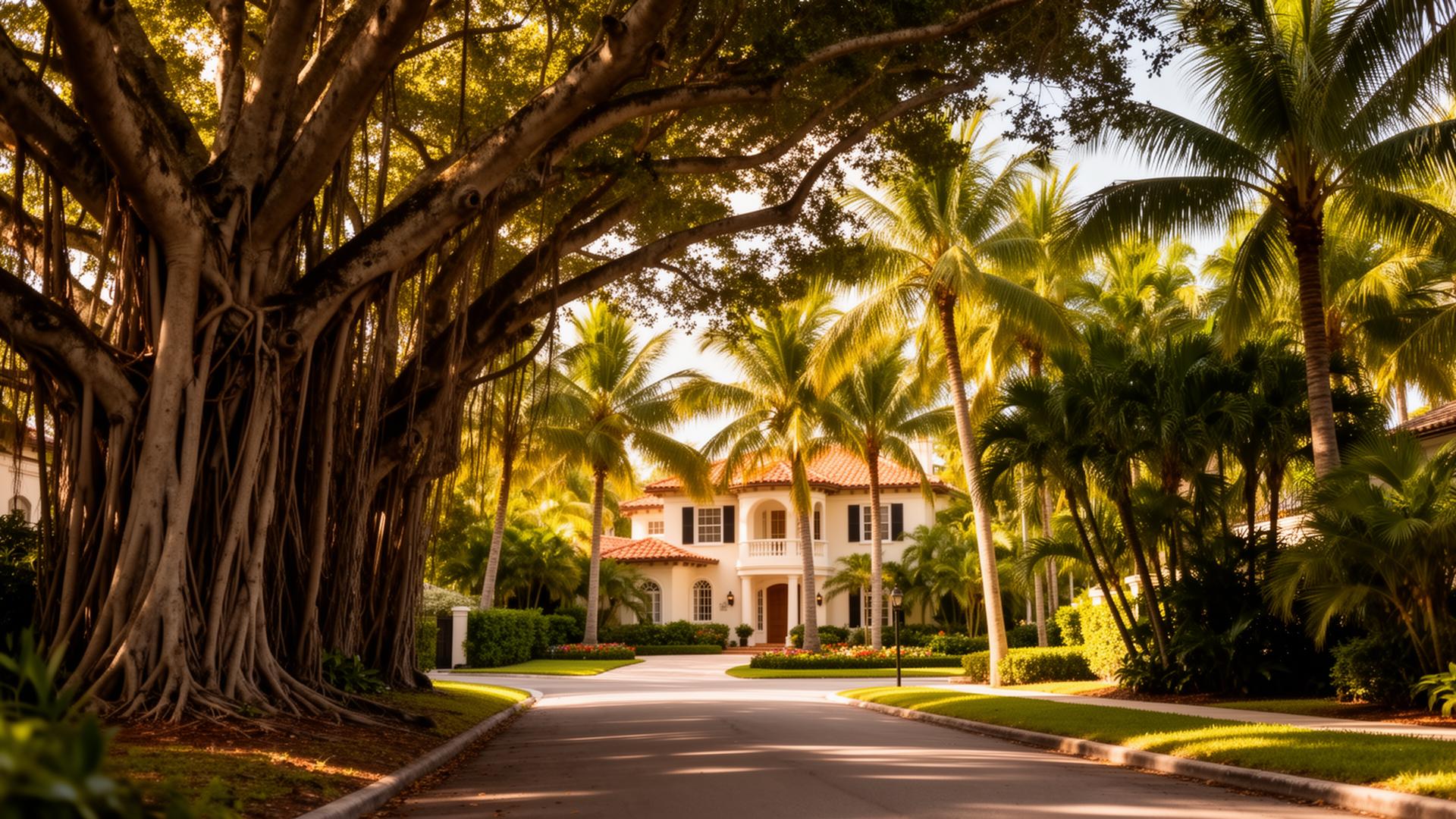
- Walk Score measures proximity, not the quality of the walk. The Grove's mature tree canopy, sidewalks, and waterfront parks make the actual experience better than a raw distance metric implies, which is part of the lifestyle premium buyers pay for.
- A strong transit and bike score matters for resale. Walkable, transit-served locations have historically held buyer demand through cycles, which is a durable-demand argument, not a guaranteed-appreciation one.
The village center
The walkability rating is anchored by a compact village center. Within a short walk you have boutiques, restaurants, cafes, the CocoWalk retail and dining complex, a Saturday organic market, and waterfront green space at Peacock Park and along the bayfront. The layout is human-scale: low-rise blocks, shaded streets, and a grid you can cover on foot rather than a planned mixed-use development bolted onto a highway.
That structure is not new. Coconut Grove is the oldest continuously inhabited neighborhood in Miami, with its village dating to the 1870s, decades before Miami itself was incorporated in 1896 [3]. The Barnacle Historic State Park, built in 1891 on the bayfront, is the oldest house in Miami-Dade County still standing on its original site [3]. The point for a buyer is that the walkable core is a 150-year-old village, not a recent master plan, which is why the streetscape and tree canopy feel settled rather than engineered.
What the price and timing data say
Here is the part that affects your offer. Two numbers do most of the work:
- Median sale price around $2.6 million, up about 52.7% year over year over the trailing three months in spring 2026 [2]. That year-over-year figure is large, and it partly reflects mix (which segments and price bands sold), not a uniform 50%-plus jump on every home. Treat it as a signal that the high end transacted, not as an appreciation rate to apply to a specific property.
- About 87.5 days on market [2]. Homes are not clearing in a weekend. Across 2026, time on market in the Grove has run longer than the frenzied prior years, which tilts negotiating leverage modestly toward prepared buyers, especially on listings that have been sitting.
The underwriting read: this is a price-dense, supply-constrained, lifestyle-driven market rather than a high-velocity one. That generally means fewer bidding wars than headline price growth might suggest, and more room to underwrite on fundamentals (condition, flood zone, insurance cost, comparable sales) than to chase. If you are weighing a Grove purchase against another neighborhood, the buyer consultation is where we put your specific budget against current comparables.
Carrying costs belong in the walkability premium
A walkable village core is a quality-of-life asset. It does not change the line items that determine whether a Grove home pencils out. Build these into any analysis:
- Property insurance and flood. South Florida coastal property carries meaningful wind and flood exposure, and the bayfront sections of the Grove sit in flood zones. Premiums vary widely by elevation, build, and flood designation, so get an actual insurance quote and a FEMA flood-zone check on the specific parcel before you commit. Do not assume a neighborhood average.
- Property taxes. Florida assesses property tax at the county level, and Miami-Dade taxes the assessed value of the home. A homesteaded primary residence is treated differently from a second home or investment property, and the taxable basis can step up at sale, so model the post-sale tax bill rather than the seller's current one.
- HOA and maintenance. Older homes and mature landscaping carry upkeep. Condos and gated enclaves carry association dues. Both belong in your monthly carrying cost, not just the mortgage.
None of this is a reason to avoid the Grove. It is the reason to underwrite a specific address rather than the neighborhood average. If you are on the sell side and want a defensible number, start with a listing valuation.
How Coconut Grove compares for a walkability-first buyer
If walkability is your filter, the Grove's distinction is the pairing, not the score alone. Several Miami areas score well on Walk Score, but most high-walkability pockets are dense, mid-rise or high-rise corridors. The Grove offers a walkable core inside a low-rise, single-family, tree-canopy neighborhood with bay access. That is a narrower supply, which supports the price-density pattern in the data.
For a buyer, the practical takeaways:
- If you want to live in the walkable core, focus on the village-adjacent blocks where the 94 score actually applies, and accept that those addresses price at a premium to the residential edges.
- If you want the neighborhood feel with a shorter walk-to-everything tradeoff, the residential streets a few minutes out cost less and still sit inside the canopy.
- Either way, the carrying-cost and flood checks above apply, and they vary block to block near the bay.
Frequently asked questions
What is Coconut Grove's Walk Score?
The central Coconut Grove area (33133) has a Walk Score of 94, which the index classifies as a "Walker's Paradise" where daily errands do not require a car. It also scores 51 for transit ("Good Transit") and 85 for biking ("Very Bikeable") [1]. The score describes the village core; outer residential blocks walk lower.
How much do homes cost in Coconut Grove?
The median sale price across Coconut Grove was about $2.6 million over the three months ending in spring 2026, up roughly 52.7% year over year, with homes taking around 87.5 days to sell [2]. That figure spans the neighborhood; specific blocks, the village core, and the bayfront price above or below it. For a property-level number, see the buyer consultation page.
Is Coconut Grove a buyer's or seller's market right now?
As of spring 2026, time on market in the Grove has been running near 87.5 days [2], longer than the prior peak years, which tends to give prepared buyers modest negotiating room, particularly on listings that have been sitting. It is a price-dense, supply-constrained market rather than a high-velocity one, so the dynamic varies by price band and condition.
Why is Coconut Grove considered historic?
Coconut Grove is the oldest continuously inhabited neighborhood in Miami. Its village dates to the 1870s, before Miami was incorporated in 1896, and the Barnacle Historic State Park (built 1891) is the oldest house in Miami-Dade County still standing on its original site [3].
What carrying costs should I budget beyond the purchase price?
Plan for property insurance (with wind and flood exposure on coastal and bayfront parcels), Miami-Dade property taxes assessed on the home's value (which can step up at sale), and HOA or maintenance costs. These vary by parcel, so get an insurance quote, a FEMA flood-zone check, and a tax estimate on the specific address. A listing valuation or buyer consultation can frame these for a given property.
A note from Gabriel
Coconut Grove is one of the neighborhoods where the lifestyle case and the underwriting case both hold up, as long as you analyze the specific address rather than the neighborhood average. If you want to walk a few properties, or get a sourced read on what a home is worth before you make an offer, reach out and we will work through the numbers together.
Gabriel
Sources
3. Wikipedia, "Coconut Grove" — https://en.wikipedia.org/wiki/Coconut_Grove
Gabriel A. Moyers, PA. eXp Realty. Florida License #3407280. Equal Housing Opportunity. This article is general information as of June 2026 and is not legal, tax, or financial advice. Verify current figures against Walk Score, Redfin, and Miami-Dade County property and tax records before acting.
Thinking of selling your luxury property in Miami? Find out what your home is worth.
Get Your Home ValuationLooking for your dream home in Miami? Take our personalized home search quiz.
Start Your Home Search Quiz