
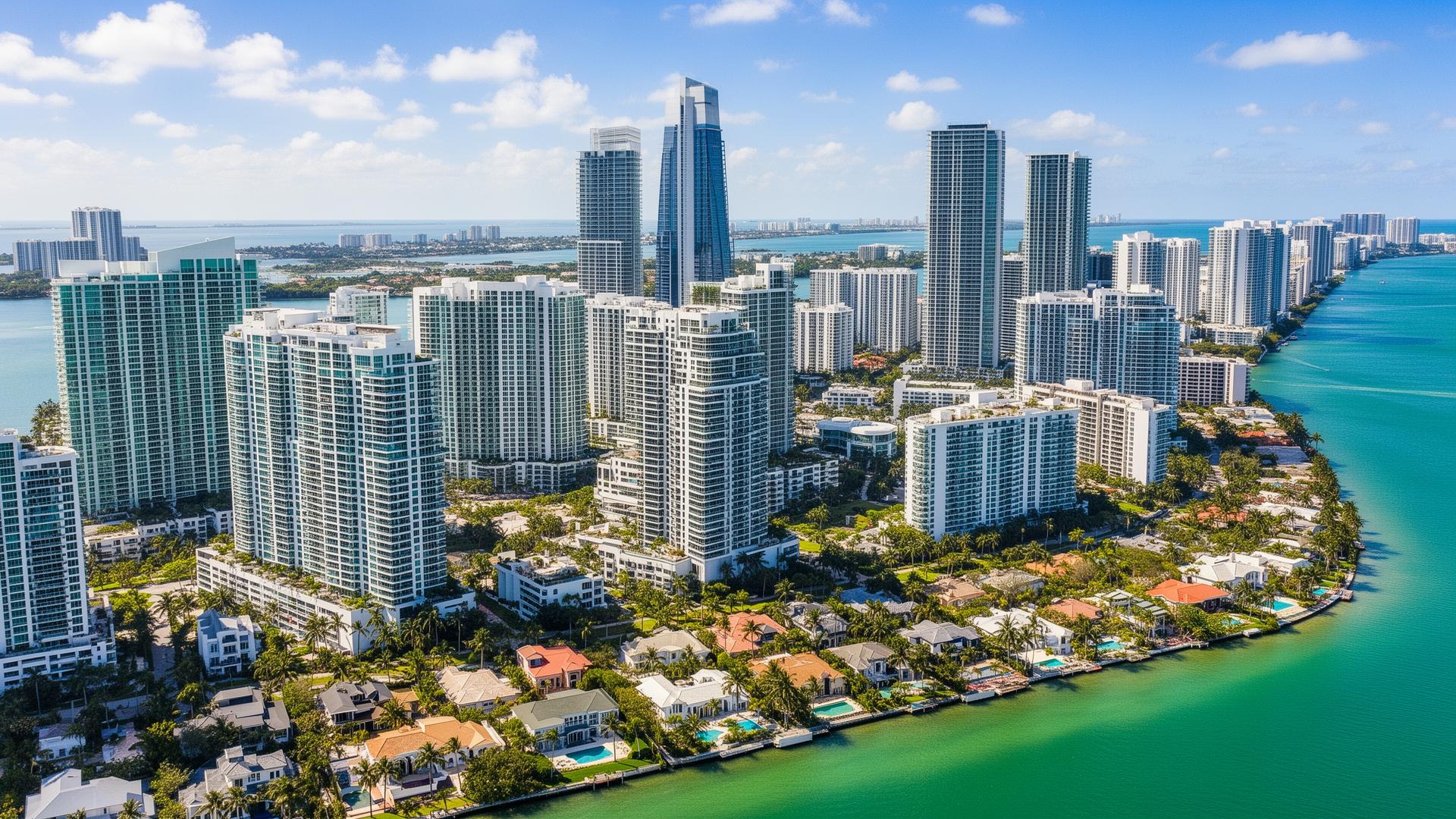
Miami vs. New York as a real estate investment
If you are underwriting Miami against New York City, the honest answer is that each market wins on a different line of the pro forma. Florida gives you no state income tax and a lower effective property tax rate, which improves after-tax cash flow. New York gives you a deeper rental market and, in many buildings, a more predictable carrying cost than a Florida condo facing new structural-reserve rules. Miami's headline tax advantage is real, but it is partly offset by the highest homeowners insurance in the country and by assessment caps that do not apply to investment property the way they apply to a primary home. This piece walks the comparison line by line, with sources, and I am a Miami agent telling you where New York is the better underwrite.
Last updated: July 2026
Price of entry: what a median home costs in each market
Start with basis, because everything else is a percentage of it. Over the three months ending May 2026, the median sale price in Miami was about $652,000 [1]. In Manhattan, the median sale price was about $1.4 million as of June 2026 [2]. That gap matters two ways. A lower Miami basis means a given amount of capital buys more square footage and more units, which is the simplest lever on cash-on-cash return. It also means Miami buyers below the $1 million line avoid New York closing taxes that only trigger at higher prices, which I cover below.
The flip side: a higher New York basis sits on top of one of the deepest rental markets in the country, so vacancy risk and the time to re-lease are structurally lower in Manhattan than in a single Miami condo tower.
Income tax: Florida's clearest advantage
This is where Florida wins outright, and it is not close. Florida levies no state income tax [3]. A New York City resident pays New York State income tax, with a top marginal rate of 10.9 percent, plus a separate New York City resident income tax on top of that, which pushes the combined top marginal rate above 14 percent [4]. Florida also has no state estate tax [3]. For a high-income owner, that spread is the single largest reason capital has moved to South Florida.
One caution that gets skipped in sales pitches: this advantage only accrues to you if you are actually a Florida resident. Owning a Miami condo while living in New York does not lower your New York tax bill, and New York audits domicile changes aggressively.
The residency trap most "move to Florida" pitches ignore
If you are relocating to capture Florida's zero income tax, you have to genuinely establish Florida domicile and sever New York residency. New York applies a statutory residency test: even if you claim Florida as your domicile, you can still be taxed as a New York resident if you maintain a permanent place of abode in New York and spend 184 or more days there in the year [5]. Any part of a day generally counts as a day, and the burden of proof is on you to document where you were [5].
Practically, that means keeping a Manhattan pied-a-terre and spending half the year in it can undo the entire Florida tax thesis. Underwrite the move, not just the property.
Property tax: Florida lower, but the cap does not follow investment property
On effective property tax rate, Florida is lower. The Tax Foundation puts Florida's effective rate on owner-occupied housing at about 0.78 percent, versus about 1.30 percent for New York [3][4]. On a like-for-like assessed value, Florida carries less annual property tax.
Here is the honest asterisk for investors. Florida's 3 percent Save Our Homes assessment cap and the homestead exemption apply to a primary residence, not to a rental or second home. Non-homestead property in Florida is capped at 10 percent per year, not 3 percent, and that cap resets to full market value the year after a sale [6]. So the property-tax protection Florida homeowners rave about is materially weaker on an investment property, and a fast-appreciating rental can see its assessed value climb up to 10 percent annually. Do not underwrite a Miami rental as if it gets the homestead treatment.
Insurance: Miami's biggest carrying-cost problem
Florida gives back part of its tax advantage through insurance. Florida has ranked as the most expensive state in the country for homeowners insurance, with average annual premiums running several times the national average, and Miami is among the most expensive markets within the state [7]. Wind, flood, and roof-age underwriting drive premiums that can move a Miami pro forma by thousands of dollars a year, and premiums have been rising, not falling.
New York City carries its own insurance cost, but it is nowhere near Florida's coastal exposure. When you compare cash flow, put a current, market-specific insurance quote into the Miami column before you get excited about the tax line. The tax savings and the insurance cost partly cancel.
New York's transaction and carry costs
New York has costs Miami does not. On purchase, New York imposes a mansion tax on residential sales of $1 million or more, running from 1 percent up to 3.9 percent of the full purchase price at the highest brackets, and it is layered on top of state and city transfer taxes [8]. That is a real, one-time drag on a New York buyer's basis that a sub-$1 million Miami buyer avoids entirely.
On ongoing carry, most New York apartments are co-ops or condos with monthly common charges or maintenance, and many co-ops also charge a flip tax on resale. Those are predictable, budgeted line items. Miami condos have their own association dues, which brings us to the risk that is specific to this market right now.
The Miami-specific risk: condo special assessments after SB 4-D
After the 2021 Surfside collapse, Florida enacted Senate Bill 4-D, which requires milestone structural inspections for buildings three stories and taller and mandates structural integrity reserve studies, with reserves that must be funded rather than waived [9]. Buildings near the coast face inspection at 25 years rather than 30 [9].
For a Miami condo investor, this is the line item to stress-test. Older waterfront towers that deferred maintenance for years are now facing large one-time special assessments to fund reserves and repairs, and those assessments can land on an owner with little notice. New York co-ops handle major capital work differently, typically through the board's control of maintenance charges and assessments over time, which tends to be more gradual. If you are buying a Miami condo, read the reserve study and the milestone inspection status before you sign, and read about the Brickell condo market specifically if that is your target.
So which is the better investment?
There is no single answer, and anyone who gives you one is selling. If you will actually move, establish Florida domicile, and buy a newer building or a single-family home, Miami's zero income tax and lower property-tax rate can produce a stronger after-tax return, provided you fund the insurance line honestly. If you want a lower-volatility rental in a deep leasing market, are staying in New York, or want to avoid concentrated condo-assessment risk, New York can pencil out better despite the higher basis and transaction taxes.
Underwrite both columns fully before you decide. If you want a data-backed read on a specific Miami property or a realistic carrying-cost estimate, start with a buyer consultation or run a current number through a listing valuation.
Frequently asked questions
Is Miami really cheaper to own than New York?
On purchase price and income tax, yes. The median Miami home is roughly half the price of the median Manhattan home [1][2], and Florida has no state income tax [3]. But Miami's insurance is the highest in the country [7], and investment property does not get the 3 percent homestead assessment cap [6], so the gap narrows once you underwrite full carrying costs.
Do I get Florida's tax break if I keep living in New York?
No. Florida's zero income tax only helps if you are a Florida resident. If you keep a permanent place of abode in New York and spend 184 or more days there, New York can still tax you as a resident under its statutory residency test [5].
What is the biggest hidden risk in a Miami condo?
Structural special assessments. Under Florida's SB 4-D, older and coastal condo buildings must complete milestone inspections and fund structural reserves, which has triggered large one-time assessments in some buildings [9]. Review the reserve study before buying.
What extra taxes do New York buyers pay that Miami buyers do not?
New York charges a mansion tax of 1 percent to 3.9 percent on residential purchases of $1 million or more, on top of state and city transfer taxes [8]. Many co-ops also charge a flip tax on resale.
Does Miami property tax stay low forever?
Not on an investment property. The 3 percent Save Our Homes cap applies to a homesteaded primary residence. Non-homestead property is capped at 10 percent per year and is reassessed to market value after a sale [6].
Gabriel
Sources
- Redfin, Miami, FL Housing Market
- Redfin, Manhattan, NY Housing Market
- Tax Foundation, Florida Tax Rates and Rankings
- Tax Foundation, New York Tax Rates and Rankings
- New York State Department of Taxation and Finance, Permanent Place of Abode
- Miami-Dade County Property Appraiser, Non-Homestead Cap
- Insurify, Florida Home Insurance Report
- New York State Department of Taxation and Finance, Real Estate Transfer Tax
- Florida Senate, Senate Bill 4-D (2022)
Gabriel A. Moyers, PA. eXp Realty. Florida License #3407280. Equal Housing Opportunity. This article is general information as of July 2026 and is not legal, tax, or financial advice. Verify current figures against authoritative sources before acting.
Thinking of selling your luxury property in Miami? Find out what your home is worth.
Get Your Home ValuationLooking for your dream home in Miami? Take our personalized home search quiz.
Start Your Home Search Quiz