
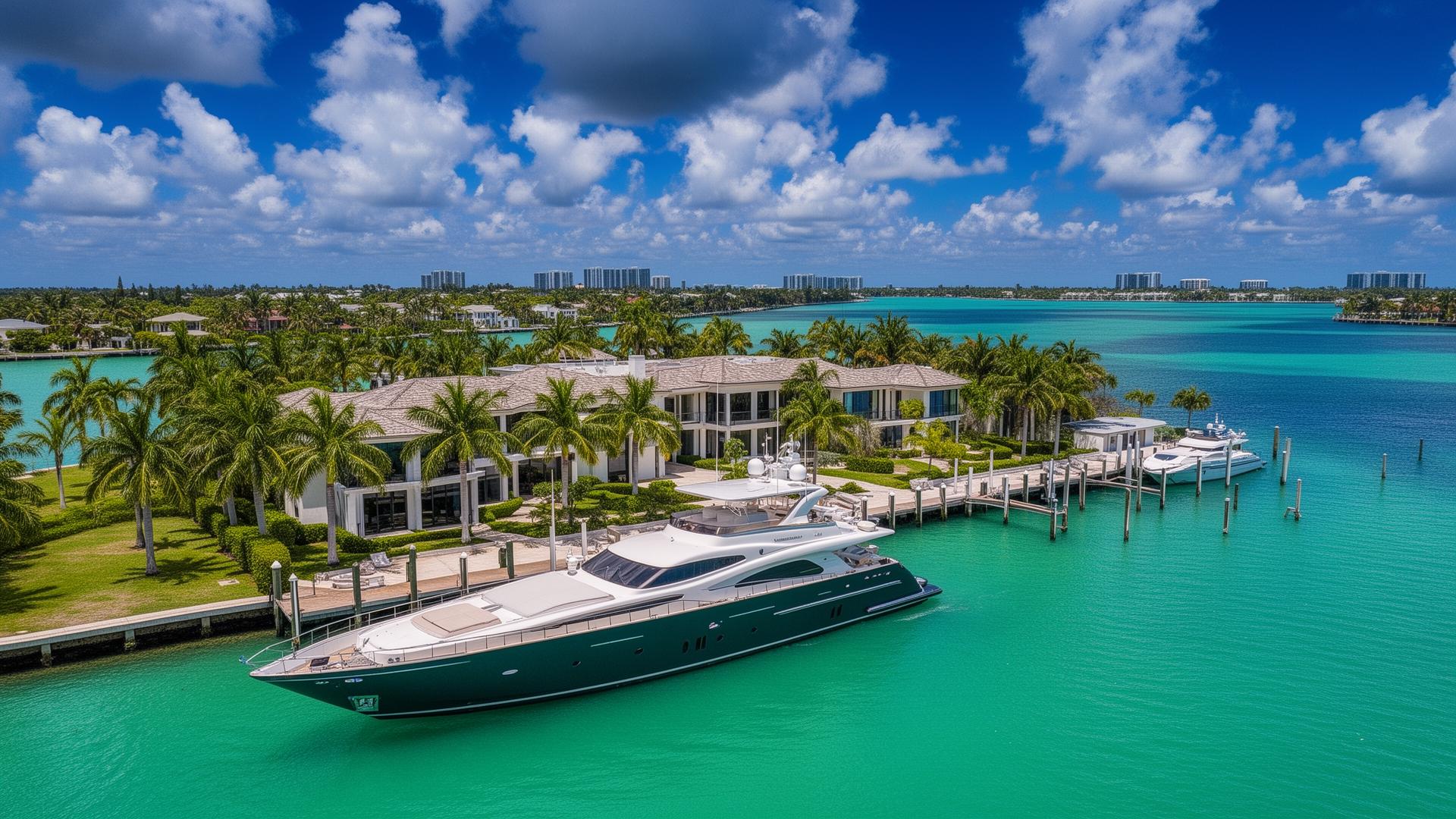
Coconut Grove Waterfront Estates: A 2026 Buyer's Market Guide
Last updated: June 2026
If you are shopping Coconut Grove waterfront estates, here is the short version. As of February 2026, Coconut Grove waterfront homes were listed at a median of roughly $2.7 million, against a neighborhood-wide median sale price near $2.5 million [1]. The waterfront premium is real, but it is not uniform. In the $1 million to $3 million band, homes trade around $1,000 per square foot and tend to move inside 60 days; in the $6 million to $10 million tier, well-finished bayfront product can clear $1,500 per square foot but can also sit far longer, with one segment of that tier averaging well over 300 days on market in mid-2025 [2]. Translation: there is no single Grove waterfront price. There is a price for direct bay frontage with a deep-water dock, a different price for a canal-front lot, and a different one again for a bay-view home set back from the seawall.
This guide walks through how to underwrite a Coconut Grove waterfront purchase: what drives the premium, what a dock is actually worth, and the two recurring costs (insurance and property tax) that most out-of-state buyers underestimate. If you would rather talk through a specific property, a buyer consultation is the fastest path. Otherwise, read on.
Why Coconut Grove waterfront commands a premium
Coconut Grove sits on the western shore of Biscayne Bay, which gives it something most of inland Miami-Dade does not have: navigable saltwater access, mature tree canopy, and a walkable village core. That combination is what buyers are paying for, and it is why the neighborhood trades at a multiple of the county.
For context, the Miami-Dade median single-family sale price was $675,000 in May 2025, up 3.8% year over year, and that month marked the 162nd consecutive month of annual price appreciation in the county since December 2011 [3]. Coconut Grove's neighborhood median, near $2.5 million, runs roughly three to four times the county figure [1]. The delta is the Grove premium, and waterfront frontage sits at the top of it.
A few drivers worth separating in your underwriting:
- Frontage type. Open-bay frontage prices differently from a canal or a finger of water. Bay frontage carries higher exposure and higher value; canal lots can offer protected dockage at a lower entry point.
- Water depth and dock rights. A documented deep-water dock that can hold a real vessel is a hard asset. A seawall with no dock permit is a future expense.
- Setback and elevation. Homes set back from the seawall, or elevated, carry a different risk and insurance profile than slab-on-grade homes at the water's edge.
What a private dock is actually worth
A dock is the part of a waterfront listing most likely to be mispriced, in either direction. Two questions decide its value.
First, is the existing dock permitted and conforming? In Miami-Dade, accessory dock structures are governed by local code and, near the coast, by state rules. Florida's Department of Environmental Protection regulates construction seaward of the Coastal Construction Control Line, and local rules generally cap dock height and how far a dock may protrude past the seawall [4]. A dock built without permits is not a feature you are buying; it is a liability you are inheriting, and it can complicate financing and resale.
Second, what can the water actually hold? Charted depth at mean low water, bridge clearances on the route to open bay, and turning room all determine whether the dock fits a center console or a 60-foot yacht. Those are not cosmetic details; they set the ceiling on the buyer pool when you eventually sell. Underwrite the dock as its own line item, not as a rounding error on the house.
The two carrying costs buyers underestimate
A Coconut Grove waterfront estate is not just a purchase price. The recurring costs that move the math most are insurance and property tax.
Insurance and flood coverage
Waterfront and coastal homes carry higher insurance exposure than inland Miami-Dade, driven by wind risk, flood zone, distance to open water, and roof age. The flood-coverage requirement matters specifically here: Florida law requires flood insurance for Citizens Property Insurance policyholders whose dwelling coverage is $400,000 or more, with lower-coverage policies phasing in by January 1, 2027 [5]. Most Grove waterfront estates clear that $400,000 dwelling threshold easily, so flood coverage should be treated as a fixed cost, not an optional add-on. Get a current flood determination and a real insurance quote during diligence, before you are emotionally committed to the house.
Property tax and the homestead cap
Florida has no state income tax, which is part of the migration story, but property tax on a multimillion-dollar estate is a meaningful annual line. The lever that matters for a primary residence is the homestead exemption and its Save Our Homes cap.
Save Our Homes, passed by Florida voters as Amendment 10 in 1992, limits the annual increase in a homesteaded property's assessed value to 3%, or the change in the Consumer Price Index, whichever is lower [6]. For 2025 that cap came in at 2.9% under the CPI [6]. The practical effect: once you homestead and hold, your taxable assessment can drift well below market value over time. For a buyer planning to make the Grove home a primary residence, that cap is part of the long-term carry, and it does not transfer at the prior owner's low basis when you buy. If you are also weighing the sale of an existing Florida home, the sell your Miami home page covers how portability can move part of your accrued Save Our Homes benefit to the new property.
How to read a Grove waterfront listing in 2026
A few habits that separate a clean purchase from an expensive surprise:
- Price the frontage, then the house. Comparable sales should match on frontage type and dock capacity first, square footage second. A bay-view home and a bay-front home are not comps.
- Verify the dock paper, not the dock photo. Ask for permits and any DEP or county approvals before you fall for the sunset shot.
- Quote insurance early. A flood and wind quote during diligence can move your real annual cost by five figures. Better to know in week one.
- Underwrite days on market by tier. In mid-2025, $1M–$3M Grove product moved inside 60 days while parts of the $6M–$10M tier averaged well over 300 days [2]. Slower segments give you more negotiating room; faster ones do not.
None of this is exotic. It is the same discipline you would apply to any asset where the headline number hides three or four embedded costs. The Grove rewards patient, sourced underwriting.
If you want a current pull of active waterfront inventory and recent closed comps for a specific frontage type, browse Miami luxury homes for sale or send me the criteria directly and I will run it.
Frequently asked questions
What is the median price of a Coconut Grove waterfront home in 2026? As of February 2026, waterfront homes in Coconut Grove were listed at a median of roughly $2.7 million, against a neighborhood-wide median sale price near $2.5 million, according to Redfin [1]. Waterfront product trades at a premium to the broader neighborhood, and pricing varies widely by frontage type and dock capacity.
How much more do Coconut Grove waterfront homes cost than inland Miami? The Miami-Dade county median single-family price was $675,000 in May 2025 [3], while Coconut Grove's neighborhood median ran near $2.5 million [1], roughly three to four times the county figure. Direct bay frontage sits at the upper end of that premium.
Do I need flood insurance on a Coconut Grove waterfront estate? For Citizens Property Insurance policyholders, Florida law requires flood insurance when dwelling coverage is $400,000 or more, with lower-coverage policies phasing in by January 1, 2027 [5]. Most Grove waterfront estates clear that threshold, so flood coverage is effectively a required carrying cost. Confirm the flood zone and a real quote during diligence.
How does Florida's homestead cap affect a waterfront purchase? If the home is your primary residence, the Save Our Homes cap limits annual assessed-value increases to 3% or CPI, whichever is lower; for 2025 that cap was 2.9% [6]. The benefit accrues while you hold and does not transfer at the seller's lower basis, so budget property tax off your purchase price, not the prior owner's assessment.
Can I build or replace a dock on a Coconut Grove waterfront lot? Docks are governed by local Miami-Dade code and, near the coast, by Florida DEP rules for construction seaward of the Coastal Construction Control Line, including limits on dock height and protrusion past the seawall [4]. Always verify existing permits, and treat an unpermitted dock as a cost to remediate, not a feature.
What to do next
If you are evaluating a specific Coconut Grove waterfront estate, I can pull current comps by frontage type, flag the dock and insurance questions worth asking, and tell you where the negotiating room sits. Start with a buyer consultation, or if you are weighing a sale on the other side of the move, request a listing valuation. No pressure either way; I am happy to be a second set of eyes.
Gabriel
Sources
Gabriel A. Moyers, PA. eXp Realty. Florida License #3407280. Equal Housing Opportunity. This article is general information as of June 2026 and is not legal, tax, or financial advice. Verify current figures against Redfin, MIAMI REALTORS, and the Miami-Dade County Property Appraiser before acting.
Thinking of selling your luxury property in Miami? Find out what your home is worth.
Get Your Home ValuationLooking for your dream home in Miami? Take our personalized home search quiz.
Start Your Home Search Quiz