
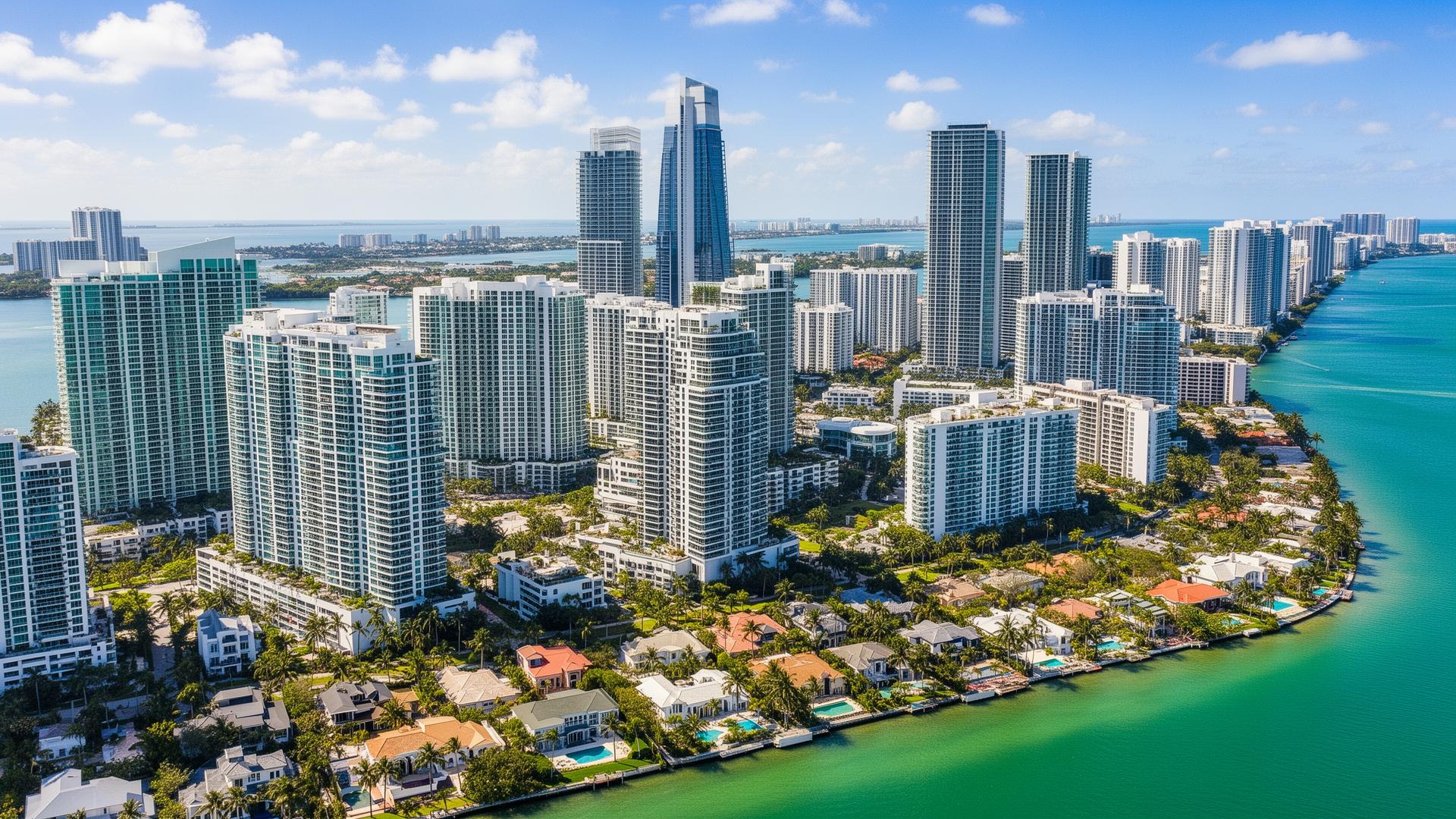
Miami commercial real estate market outlook 2026
Last updated: June 2026
The Miami commercial real estate market enters 2026 split by sector. Office is tightening on the back of Brickell finance demand, with vacancy at 15.0% and average asking rents up year over year [1]. Industrial is recalibrating as new supply lands, pushing vacancy to 7.1% even as rents keep climbing [2]. Retail remains the tightest segment at 2.9% vacancy, though asking rents have softened from their peak [3]. If you are underwriting an acquisition or a lease this year, the headline is that there is no single Miami story right now. Each asset class is on its own cycle, and pricing reflects that.
This outlook walks through office, industrial, and retail fundamentals with current figures from CBRE and Colliers, plus how the lending environment frames deals in 2026. The lens here is underwriting, not hype.
Office: a tightening market led by Brickell finance demand
Miami office has been one of the few U.S. markets posting positive momentum. CBRE reported overall vacancy of 15.0% in Q1 2026, down about 1.1 percentage points from a year earlier, with average asking rents at $66.16 per square foot, up 5.3% year over year [1]. That is a divergence from the national office picture, where vacancy has stayed elevated.
The demand driver is real and worth naming precisely. Financial and professional services firms have expanded into Brickell over the past several years, and that absorption shows up in the trophy tier. 830 Brickell, a 640,000-square-foot Class A office tower, completed in October 2024 fully leased, with a tenant roster that includes Microsoft, Citadel, and several large law firms [4]. New stand-alone Class A supply in Brickell had been scarce for over a decade before it, which is part of why top-tier rents have held.
For tenants, the practical takeaway is the gap between trophy and commodity space. The flight to quality means newer Class A product commands a premium, while older inventory carries higher vacancy and more negotiating room. If you are a buyer or investor, that spread is where the underwriting work lives. A Class B repositioning play and a stabilized Class A asset are different risk profiles at different cap rates.
If you want to understand how this office demand connects to the residential side of the same submarket, the Brickell neighborhood guide covers the broader district.
Industrial: recalibrating as new supply delivers
Miami-Dade industrial spent 2025 absorbing a wave of new construction. Colliers reported the overall vacancy rate rising to 7.1% in Q1 2026, up from 6.8% at the end of 2025, as completed projects added inventory faster than tenants could absorb it [2]. Asking rents still moved up, reaching $17.04 per square foot triple-net in Q1 2026 [2].
This is a normalization, not a downturn. The market remains anchored by the Port of Miami and Miami International Airport, which make Miami-Dade a logistics gateway for trade with Latin America and the Caribbean. Within the overall number, the small-bay segment has stayed far tighter than big-box, so the headline vacancy figure can understate how hard it is to find functional space in some size ranges.
For investors, the underwriting question in 2026 is supply timing. With several large projects delivering, rent growth has moderated from the double-digit pace of prior years. That favors buyers who can be patient on lease-up assumptions over those modeling aggressive mark-to-market rent bumps.
Retail: the tightest segment, with rents off their peak
Retail is the inverse of industrial right now. Colliers put Miami-Dade retail vacancy at 2.9% in Q4 2025, among the tightest in the country, with leasing activity outpacing new supply for the year [3]. At the same time, average asking rents settled at $41.97 per square foot triple-net, down roughly 9% from a year earlier as new construction repriced the average [3].
The low vacancy reflects limited new retail development and steady demand for well-located space. Mixed-use and experiential formats continue to lease, particularly in walkable districts. For an investor, tight vacancy supports occupancy assumptions, but the rent decline is a reminder to underwrite to in-place economics rather than to a peak-of-cycle comp.
The lending and investment climate in 2026
The capital markets backdrop is steadier than it was in 2023 and 2024, when rapid rate moves stalled deal volume. A more predictable lending environment in 2026 lets institutional and private capital underwrite with more confidence, but financing costs are still materially higher than the early-2020s lows. That keeps a floor under cap rates and rewards conservative leverage.
The practical implication is that sector selection matters more than market timing. An office trophy asset, an infill industrial building, and a grocery-anchored retail center face different supply, rent, and absorption dynamics in this same market. Underwriting each on its own fundamentals beats treating Miami as one trade.
Frequently asked questions
What is the Miami office vacancy rate in 2026?
CBRE reported Miami office vacancy at 15.0% in Q1 2026, down about 1.1 percentage points year over year, with average asking rents around $66.16 per square foot [1].
How is the Miami-Dade industrial market doing in 2026?
Colliers reported industrial vacancy at 7.1% in Q1 2026, up from 6.8% at the end of 2025 as new supply delivered, with asking rents at $17.04 per square foot triple-net [2].
Why is Miami retail rent falling if vacancy is so low?
Retail vacancy was 2.9% in Q4 2025, but average asking rents fell roughly 9% year over year to $41.97 per square foot triple-net as new construction repriced the market average [3]. Tight vacancy and softer asking rents can coexist when the rent mix shifts.
Is 830 Brickell fully leased?
830 Brickell, a 640,000-square-foot Class A office tower, completed in October 2024 fully leased, with tenants including Microsoft, Citadel, and several large law firms [4].
Which Miami commercial sector is best for investors in 2026?
There is no single answer. Office, industrial, and retail are on different cycles, so the right sector depends on your return targets, hold period, and risk tolerance. Underwrite each asset on its own fundamentals.
If you are weighing an acquisition or want a read on an asset you already hold, a buyer consultation or a valuation of your current holdings is a practical starting point.
Gabriel
Sources
- CBRE, Miami Office Figures Q1 2026
- Colliers, Miami-Dade County Industrial Market Report Q1 2026
- Colliers, Miami-Dade County Retail Market Report Q4 2025
- Cain International, OKO Group & Cain International Complete Miami's 830 Brickell Office Tower
Gabriel A. Moyers, PA. eXp Realty. Florida License #3407280. Equal Housing Opportunity. This article is general information as of June 2026 and is not legal, tax, or financial advice. Verify current figures against authoritative sources before acting.
Thinking of selling your luxury property in Miami? Find out what your home is worth.
Get Your Home ValuationLooking for your dream home in Miami? Take our personalized home search quiz.
Start Your Home Search Quiz