
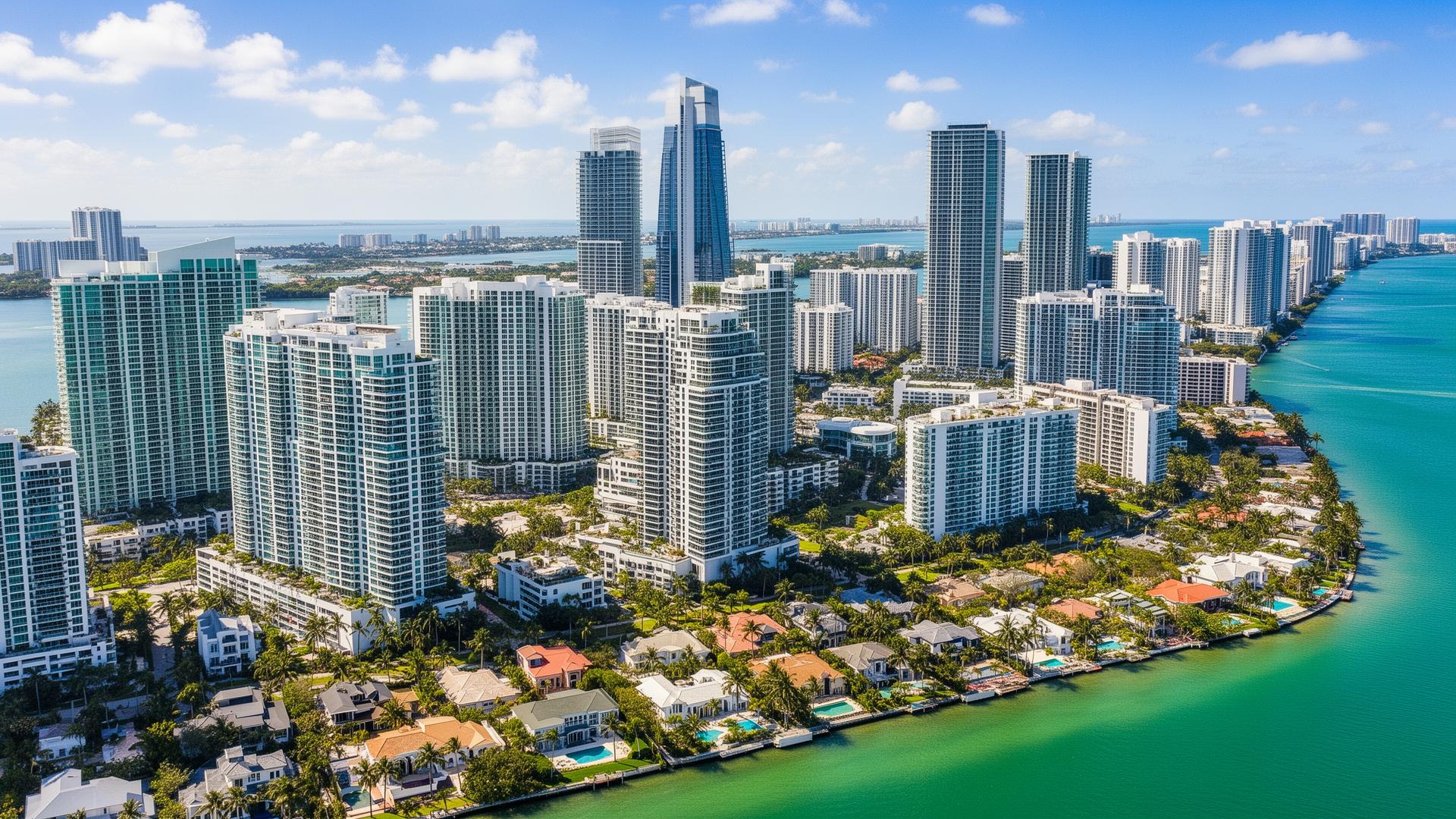
Miami Multifamily Cap Rates: 2026 Outlook and Underwriting Strategy
Last updated: June 2026
Miami multifamily cap rates sat near 5.79% for the Miami market area on a year-to-date basis through September 2025, with Fort Lauderdale at 6.27% and Palm Beach near 4.98% [1]. Those Southeast Florida yields ran wider than Manhattan (5.24%), Los Angeles (4.86%), and Washington, D.C. (4.47%) over the same period [1], which is a reversal from the compressed pricing of the early 2020s. By property class, recent data put Class A near 4.74%, Class B near 4.92%, and Class C near 5.38% [1]. Heading into 2026, the underwriting question is not whether yields stay flat but whether net operating income holds up against higher insurance carry, a heavy delivery pipeline, and a maturity wall that is forcing some owners to sell. This post walks through where Miami multifamily cap rates stand as of late 2025, what is moving them, and how an investor might underwrite the 2026 market by submarket. If you want a current read on a specific building, you can start with a listing valuation.
Where Miami multifamily cap rates stand as of late 2025
The headline is that South Florida repriced. Through Q3 2025, the Miami market area cleared roughly 5.79% on multifamily transactions, Fort Lauderdale 6.27%, and Palm Beach 4.98% [1]. That spread between counties matters more than any single citywide average, because it reflects different supply, vacancy, and rent dynamics in each market.
Two numbers frame the demand side. Miami market-area rents grew about 1.7% year over year in Q3 2025 to roughly $2,557, while Fort Lauderdale grew 0.5% and Palm Beach 0.6% [1]. So Miami led the region on rent growth, but at a single-digit pace, not the double-digit print of the post-pandemic stretch. Vacancy in buildings with 50 or more units sat near 9.1% in the Miami market area in Q3 2025, just above the 9.0% national figure, with Fort Lauderdale at 7.9% and Palm Beach at 7.3% [1]. Higher vacancy in the Miami core is a direct function of new supply, which is the next piece.
What is moving cap rates in 2026
Three forces are doing most of the work: new supply, insurance carry, and debt maturities. None of them is speculative. Each shows up in the underwriting.
New supply and absorption
Miami-Dade is absorbing a large delivery pipeline. Year-to-date through Q3 2025, roughly 6,282 units were delivered in buildings with more than 50 units, outpacing net absorption of about 4,983 units in the Miami market area [2]. When deliveries run ahead of absorption, landlords lose pricing power, vacancy drifts up, and buyers gain leverage. That is part of why Miami-area cap rates widened relative to the early-2020s lows. For 2026 underwriting, the practical takeaway is to stress-test concessions and lease-up timelines in submarkets with heavy new construction rather than assuming day-one stabilized rents.
Insurance is now a core line item
Property insurance moved from a footnote to a structural cost in Florida underwriting. A Federal Reserve analysis found that average multifamily insurance cost rose from about $39 per unit per month in 2019 to about $68 per unit per month in 2024, an increase of more than 75% in real terms [3]. The same study found owners pass through only a fraction of that increase to rents, on the order of 25 to 40 cents per dollar, so most of the cost lands on net operating income [3]. That is the mechanism behind cap-rate expansion: when a fixed expense rises and cannot be fully passed through, buyers require a higher yield to compensate.
There is a stabilizing counter-trend worth noting. Florida regulators report that average requested rate hikes fell from about 21% in 2023 to roughly 0.2% in 2025 after the state's insurance reforms, and Citizens Property Insurance has moved toward premium reductions for many policyholders beginning in 2026 [4]. Stabilizing premiums do not undo the higher baseline, but they reduce the year-over-year shock that made 2022 and 2023 deals hard to underwrite.
The 2026 debt maturity wall
A meaningful share of multifamily debt is coming due. Industry estimates put multifamily loan maturities near $104 billion in 2025, rising roughly 56% to about $162 billion in 2026, with a similar volume in 2027 [5]. Owners who locked low fixed rates years ago face refinancing at materially higher rates, and many deals now require fresh equity to clear a refinance [5]. For a buyer with capital, that pressure is the most concrete 2026 opportunity: motivated sellers who cannot or will not recapitalize. This is where disciplined underwriting and a clear hold thesis tend to be rewarded. A buyer consultation is where we would map that thesis to a specific deal.
Submarket strategy by yield profile
Cap rates describe price; strategy describes how you earn the return. Miami breaks into a few distinct plays.
Core urban: Brickell, Edgewater, Downtown
The urban core trades at the tightest yields in the region, closer to the Class A range near 4.74% [1], because buyers pay for location, newer construction, and corporate demand. The trade-off is thinner cash flow and more exposure to the new-supply pipeline that is pushing Miami-area vacancy toward 9% [1]. This is an appreciation-and-quality play, not a yield play, and it should be underwritten with conservative lease-up assumptions where new towers are delivering nearby.
Value-add: older garden-style stock
For investors targeting higher yields, the path runs through older Class B and Class C product, where market cap rates sat nearer 4.92% and 5.38% respectively in 2025 [1], with additional yield available through renovation. The return here is manufactured, not bought: upgrading dated units, improving operations, and lifting net operating income. The risk is execution and the same insurance and financing costs that pressure every Miami deal, so renovation budgets and post-renovation rents both need to be sourced from real comparables, not assumptions.
Stability-focused suburban markets
Lower-vacancy suburban submarkets offer steadier cash flow and a more defensive profile. The trade-off is less near-term upside and, often, tighter pricing. For an investor whose objective is durable income rather than a value-add multiple, these markets can be the better fit. If you are weighing whether to hold, refinance, or sell an existing position, a current valuation of your Miami property is the starting point.
How to underwrite a Miami multifamily deal in 2026
A few principles follow directly from the data above. First, underwrite net operating income, not headline rent, because insurance and other carry costs now move the deal as much as the rent roll [3]. Second, stress vacancy and concessions in supply-heavy submarkets where deliveries are outrunning absorption [2]. Third, treat the maturity wall as a sourcing channel: in 2026, some of the better risk-adjusted entries will come from owners facing a refinance they cannot complete [5]. Fourth, keep Florida's demand backdrop in view without overstating it. Florida has no state individual income tax [6], and Census data show roughly 500,000 people moved to the state in 2024 [7], which supports rental demand over a multi-year hold even when near-term rent growth is modest.
Frequently asked questions
What is a good cap rate for Miami multifamily in 2026?
There is no single number, because it depends on class and submarket. As of year-to-date September 2025, the Miami market area transacted near 5.79%, with Class A around 4.74%, Class B around 4.92%, and Class C around 5.38% [1]. Value-add buyers generally target yields above the stabilized Class C level to compensate for renovation and execution risk. Verify current figures against MIAMI REALTORS and Yardi Matrix data before underwriting a specific deal.
How do insurance costs affect Miami multifamily cap rates?
Higher insurance reduces net operating income, and because owners pass through only about 25 to 40 cents of each dollar of insurance increase to rents, the rest lowers income and pushes cap rates wider [3]. Average multifamily insurance cost rose from roughly $39 to $68 per unit per month between 2019 and 2024 [3]. Premium increases have begun to stabilize after Florida's reforms, which helps with forecasting [4].
Is Miami multifamily rent still growing in 2026?
Rent growth has cooled to single digits. Miami market-area rents grew about 1.7% year over year in Q3 2025, leading South Florida but well below the double-digit increases of the early 2020s [1]. Heavy new supply, with deliveries outpacing absorption in Miami-Dade, is the main reason for the slowdown [2].
Why might 2026 be an active year for multifamily acquisitions?
A large volume of multifamily debt matures in 2026, estimated near $162 billion, up about 56% from 2025 [5]. Owners who financed at low rates and now face higher refinancing costs may sell rather than inject new equity, which can create acquisition opportunities for well-capitalized buyers [5].
Does Florida's tax environment really support multifamily demand?
It is one supporting factor, not a guarantee. Florida levies no state individual income tax [6], and roughly 500,000 people moved to the state in 2024 according to Census estimates [7]. That inbound migration supports rental demand over a multi-year hold, but it does not override near-term supply and financing dynamics in any given submarket.
Sources
6. Tax Foundation, Florida Tax Rates and Rankings — https://taxfoundation.org/location/florida/
If you are weighing a Miami multifamily acquisition or thinking through a hold-versus-sell decision on a building you already own, I am happy to walk through the numbers with you. You can reach me through the contact options on the site, and I will give you a straight read on how a specific deal pencils.
Gabriel
Gabriel A. Moyers, PA. eXp Realty. Florida License #3407280. Equal Housing Opportunity. This article is general information as of June 2026 and is not legal, tax, or financial advice. Verify current figures against MIAMI REALTORS, Yardi Matrix, and Federal Reserve data before acting.
Thinking of selling your luxury property in Miami? Find out what your home is worth.
Get Your Home ValuationLooking for your dream home in Miami? Take our personalized home search quiz.
Start Your Home Search Quiz