
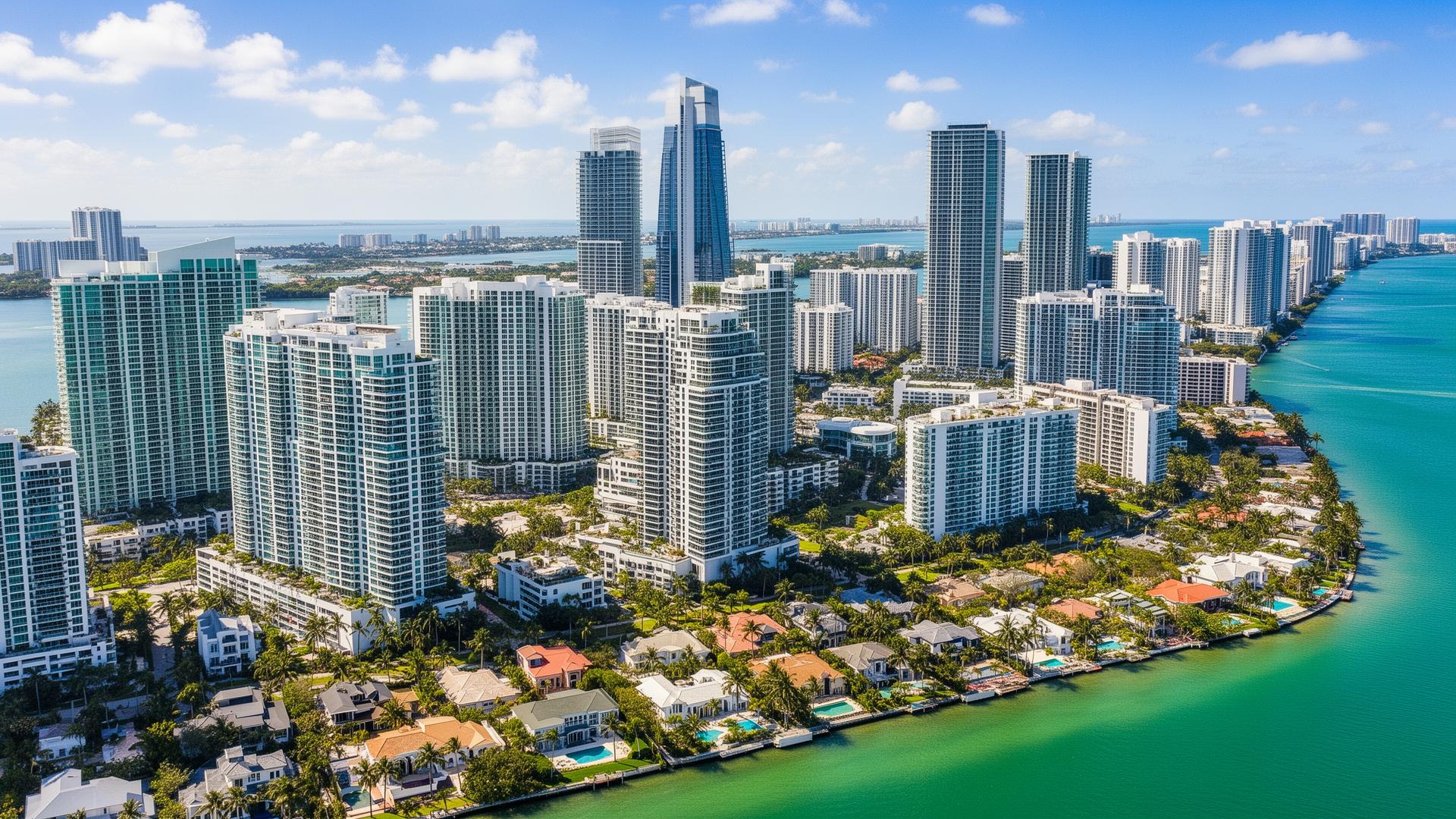
Miami cap rates in 2026: an investment yield analysis
A cap rate is a property's net operating income divided by its price, and it is the fastest way to compare the unlevered yield of two income properties. In Miami as of Q1 2026, the sourced national benchmarks that anchor pricing are net-lease: single-tenant net-lease properties averaged a 6.80% cap rate and net-lease retail averaged 6.55% [1]. Residential rental cap rates in Miami are not published as a single reliable metro figure, so they should be underwritten from current comparable sales rather than quoted as a blanket range. The reason cap rates matter in 2026 is the cost of capital: the Federal Reserve held its target range at 3.50% to 3.75% in June 2026, which keeps a floor under cap rates and disciplines pricing [2].
Last updated: July 2026
What a cap rate is, and is not
Cap rate equals net operating income (NOI) divided by purchase price. It assumes an all-cash purchase and measures the property's intrinsic yield before financing. It is not your actual return if you use debt; that is the cash-on-cash return, which depends on your loan terms. In a higher-rate environment, the gap between the cap rate and the cash-on-cash return narrows or inverts when borrowing costs approach or exceed the cap rate, which is exactly why 2026 buyers underwrite both.
The sourced benchmarks
The most reliable current cap-rate data is in the net-lease sector, where transactions are frequent and reported. As of Q1 2026, The Boulder Group reported [1]:
- Single-tenant net-lease overall: 6.80%
- Net-lease retail: 6.55%
- Net-lease industrial: 7.15%
- Net-lease office: 7.90%
These are national averages and the starting point for pricing a Miami asset, which then adjusts for tenant credit, lease term, and location. I have removed the prior version's neighborhood-by-neighborhood residential cap-rate ranges (the 4.0% to 6.2% figures) because I could not source them to a named report, and quoting unsourced yields would mislead your underwriting.
Why residential cap rates need property-level underwriting
Unlike net lease, Miami residential rental cap rates are not published as a dependable single metro number. They vary with property class, unit mix, in-place versus market rent, and operating expenses, especially insurance. The right approach is to build the cap rate from the specific property's actual NOI and recent comparable sales, not from a headline range. For a property-specific pro forma, a buyer consultation is where you run the numbers on a real deal.
How rates and insurance move your yield
Two 2026 forces bear directly on realized yield:
- Interest rates. The Federal Reserve held the federal funds target range at 3.50% to 3.75% in June 2026, its fourth consecutive hold, with the committee split on whether the next move is a hold or a hike [2]. Stable but elevated rates keep cap rates from compressing and make cheap debt unavailable, so leverage adds less to returns than it did in 2021.
- Insurance. Florida property insurance is a material operating expense. Because it sits in the NOI, an insurance change moves the cap rate directly. Audit the actual premium during due diligence rather than estimating it.
The Florida tax factor
Florida's constitution prohibits a state personal income tax (Article VII, Section 5), so rental income is not reduced by a state income tax the way it is in high-tax states [3]. This does not change a property's cap rate, but it can improve your after-tax return relative to the same yield held in a high-tax state, and it is one reason capital continues to flow into Florida income property.
The two levers inside every cap rate
Because the cap rate is NOI divided by price, only two things can move it: the income or the price. On the income side, the levers are achievable rent, occupancy, and operating expenses. Push rent above market and you inflate the projected cap rate on paper while raising vacancy risk in reality, which is why you should underwrite to achievable rent from recent leases, not asking rent. On the expense side, insurance, taxes, and management are the largest lines, and each sits directly in NOI, so a change in any of them moves the cap rate at a given price.
On the price side, the denominator, cap rates and financing costs tend to move together. When debt gets more expensive, buyers require a higher going-in yield to make the math work, which pushes cap rates up and prices down for the same income. With the Fed holding rates at 3.50% to 3.75% in 2026 [2], cap rates have stayed disciplined rather than compressing, which is a healthier setup for a cash-flow buyer than the compressed-yield environment of 2021.
Short-term rentals and actualized yield
In some Miami submarkets, short-term rental income can raise a property's gross revenue, but it also raises operating intensity and regulatory risk. Short-term rental rules vary by municipality and can change, so a yield built on short-term rental income is only as durable as the local regulation that permits it. When you underwrite a property whose projected cap rate depends on short-term rental revenue, model a conservative fallback to long-term rent so the deal still works if the regulatory picture shifts. Treat any short-term rental premium as upside, not as the base case.
Metrics to pair with the cap rate
A cap rate is one lens. For a complete picture, also look at:
- Cash-on-cash return, which reflects your actual financing.
- Gross rent multiplier (GRM) for a quick income screen.
- Internal rate of return (IRR), which captures the full hold from acquisition to exit.
If you are considering selling an asset to trade up through a 1031 exchange, start with a current listing valuation to establish your equity position before you identify a replacement.
The reason to layer these metrics is that a cap rate can look attractive while the deal underperforms, or look thin while the deal delivers a strong total return through appreciation and amortization. In a market like Miami, where values have often moved independently of national trends, the IRR gives you a fuller picture than any single-year yield. Build the cap rate from real, verifiable NOI, then check it against cash-on-cash and IRR under realistic financing, and you will avoid the two most common mistakes: overpaying for a headline yield that depends on optimistic rent, and passing on a sound asset because its going-in cap rate looked modest.
Frequently asked questions
What is a typical cap rate in Miami for 2026?
The most reliable sourced benchmarks are net-lease: single-tenant net-lease averaged 6.80% and net-lease retail 6.55% in Q1 2026 [1]. Residential cap rates vary and should be underwritten from comparable sales for the specific property.
Why is the cap rate lower than my expected return?
The cap rate is an unlevered, all-cash yield. Your actual return (cash-on-cash) depends on financing, and with rates held at 3.50% to 3.75% in 2026, leverage adds less to returns than in low-rate years [2].
How does insurance affect a Miami cap rate?
Insurance is an operating expense inside NOI, so a higher premium lowers NOI and the cap rate at a given price. Verify the actual premium during due diligence.
Does Florida's tax structure raise cap rates?
No. Florida's lack of a state personal income tax [3] improves after-tax returns but does not change a property's cap rate, which is a pre-financing, pre-personal-tax measure.
Gabriel
Sources
- The Boulder Group, Net Lease Research Report, Q1 2026 (via Chain Store Age)
- Federal Reserve, FOMC statement, June 17, 2026
- Florida Constitution, Article VII, Section 5, via State of Florida Tax Guide
Gabriel A. Moyers, PA. eXp Realty. Florida License #3407280. Equal Housing Opportunity. This article is general information as of July 2026 and is not legal, tax, or financial advice. Verify current figures against authoritative sources before acting.
Thinking of selling your luxury property in Miami? Find out what your home is worth.
Get Your Home ValuationLooking for your dream home in Miami? Take our personalized home search quiz.
Start Your Home Search Quiz