
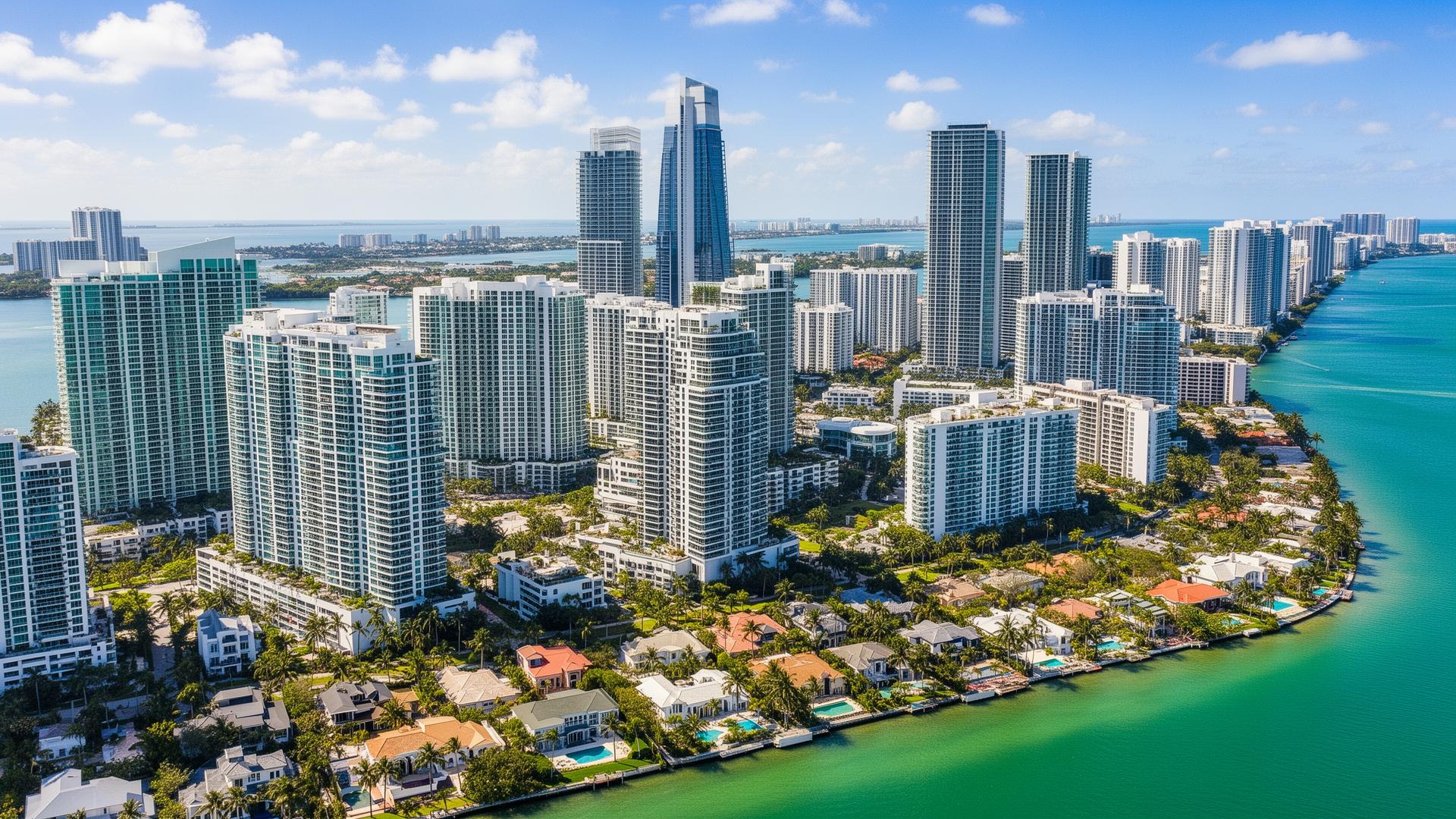
Interest Rate Impact on Miami Luxury Home Sales
Last updated: July 2026
Mortgage rates move Miami's luxury market far less than they move the rest of the country, because a large share of high-end Miami buyers pay cash. When a purchase is not financed, the 30-year mortgage rate is close to irrelevant to whether the deal closes. As of July 9, 2026, Freddie Mac's 30-year fixed-rate mortgage averaged 6.49%, down from 6.72% a year earlier [1][2]. Across all Miami-Dade sales, cash accounted for 38.7% of closings in May 2026, versus roughly 25% nationally, and the cash share climbs sharply as price rises [3][4]. So while rates set the tempo for financed, entry-level, and move-up buyers, luxury demand in neighborhoods like Miami Beach and Coconut Grove is driven more by liquidity, currency, and global capital flows than by the weekly rate print. This article explains how interest rates affect Miami luxury real estate, why the high end is less rate-sensitive, and what still matters when rates move.
What rates do to the broader market
Rates are the primary lever for financed buyers. A higher 30-year rate raises the monthly payment on a given loan, compresses how much a buyer can borrow, and thins demand at the margin. When Freddie Mac's average sits in the mid-6% range, as it did through the first half of 2026, financed buyers feel it directly in qualification and payment [1]. That is why the entry-level and move-up segments, where most purchases are financed, track rate movements closely.
The luxury tier behaves differently because its buyers are less dependent on that monthly payment. This is the core of the interest rates Miami luxury real estate story: the higher the price band, the smaller the role of the mortgage rate.
Why Miami luxury is rate-resistant: the cash-buyer share
Miami leads the nation in all-cash purchasing, and the cash share rises steeply with price. Cash represented 38.7% of all Miami-Dade sales in May 2026, well above the roughly 25% national figure [3][4]. The concentration at the top is even more pronounced: reporting on the market has noted that the all-cash share climbs from roughly a third of homes between $750,000 and $1 million to more than half of sales between $1 million and $5 million, and the great majority of $1 million-and-up condo sales in the prior year closed all cash [5].
When more than half of luxury transactions are unfinanced, the mortgage rate stops being the binding constraint. A cash buyer weighs opportunity cost, currency, and asset allocation, not a monthly payment. That is the structural reason Miami's high end can stay active while financed segments slow, and why national headlines about rate shocks do not map cleanly onto Coconut Grove or the barrier-island condo market.
Where rates still matter at the high end
Rate resistance is not rate immunity. Several channels still transmit rate moves into luxury demand.
First, financed luxury buyers exist, especially in the $1 million to $3 million band and among domestic move-up buyers who choose to finance for tax or liquidity reasons. For them, a lower 30-year rate improves affordability at the margin.
Second, rates shape the opportunity cost even for cash buyers. When safe yields are high, parking several million dollars in a non-income luxury home carries a higher implied cost, and some buyers wait. When rates ease, as they did from 6.72% to 6.49% over the year to July 2026, that opportunity cost falls and can pull discretionary buyers off the sidelines [1][2].
Third, rates affect sellers and inventory. Move-up sellers with low locked-in mortgages may be reluctant to trade into a higher rate, which constrains supply and supports prices even when demand is uneven.
If you are weighing what a rate change means for a specific home, an accurate view of value matters more than the headline rate. A current listing valuation grounds the decision in comparable sales rather than in rate sentiment. Buyers focused on the barrier islands can start with Miami Beach, while those drawn to lower-density luxury often look at Coconut Grove.
Currency and global capital
A distinctive feature of Miami luxury is the international buyer, for whom the U.S. mortgage rate is often beside the point. Foreign purchasers frequently pay cash, and their entry point is driven by the strength of the dollar against their home currency and by conditions in their home market. A favorable exchange rate can matter more to a cross-border buyer than a half-point move in the 30-year rate. This is another reason Miami's high end decouples from the domestic rate cycle in ways that inland, financed markets do not.
What this means for buyers and sellers
For luxury buyers, the takeaway is that waiting for a specific rate is usually the wrong frame. If you are paying cash, the rate barely touches your deal; inventory, pricing, and the specific asset matter far more. If you are financing, model the payment at today's rate and treat any future decline as an option to refinance, not a reason to delay a home you want.
For luxury sellers, understand that your buyer pool is not the same rate-sensitive pool that shops the median market. A large portion is unfinanced and motivated by factors rates do not control, so pricing to genuine comparable sales, and to the specific building and view, matters more than reacting to the weekly rate release.
Frequently asked questions
Do interest rates affect Miami luxury home prices?
Less than they affect the broader market. Because a large share of Miami luxury buyers pay cash, the 30-year mortgage rate has limited direct effect on high-end demand. Cash was 38.7% of all Miami-Dade sales in May 2026 and the share is even higher in the top price bands [3][5], so luxury pricing tracks liquidity, inventory, and global capital more than the weekly rate.
What is the current mortgage rate and how has it changed?
As of July 9, 2026, Freddie Mac reported the 30-year fixed-rate mortgage averaged 6.49%, down from 6.72% a year earlier [1][2]. Rates in the mid-6% range affect financed buyers most, while cash-heavy luxury segments are less sensitive.
Why do so many Miami luxury buyers pay cash?
Miami has an unusually high share of cash buyers, driven by domestic wealth, investors, and international purchasers who often transact in cash. Cash purchasing rises with price, exceeding half of sales in the $1 million-plus bands in recent reporting [5], which insulates the high end from rate moves.
Should luxury buyers wait for lower rates?
If you are paying cash, the rate is largely irrelevant, so waiting mainly risks changes in inventory and price. If you are financing, buying the right home and refinancing later if rates fall is usually a sounder plan than trying to time the rate. Base the decision on the specific asset and a current valuation.
How do currency exchange rates affect Miami luxury demand?
For international buyers, who make up a meaningful part of Miami's luxury pool and often pay cash, the strength of the dollar against their home currency can matter more than the U.S. mortgage rate. A favorable exchange rate can pull foreign buyers into the market independent of the domestic rate cycle.
Gabriel
Sources
- Mortgage Rates Hover in Mid-Six Percent Range (30-year 6.49%, July 9, 2026) - Freddie Mac / GlobeNewswire
- Freddie Mac Primary Mortgage Market Survey (PMMS)
- Miami-Dade Home Sales Rise for Ninth Consecutive Month (MIAMI REALTORS, 38.7% cash in May 2026) - PR Newswire
- Miami-Dade Total Home Sales, Single-Family Transactions Climb Again - MIAMI REALTORS
- Greater Miami Home Sales Uptick as Luxury Demand and Cash Buyers Power Market - World Property Journal
Gabriel A. Moyers, PA. eXp Realty. Florida License #3407280. Equal Housing Opportunity. This article is general information as of July 2026 and is not legal, tax, or financial advice. Verify current figures against authoritative sources before acting.
Thinking of selling your luxury property in Miami? Find out what your home is worth.
Get Your Home ValuationLooking for your dream home in Miami? Take our personalized home search quiz.
Start Your Home Search Quiz