
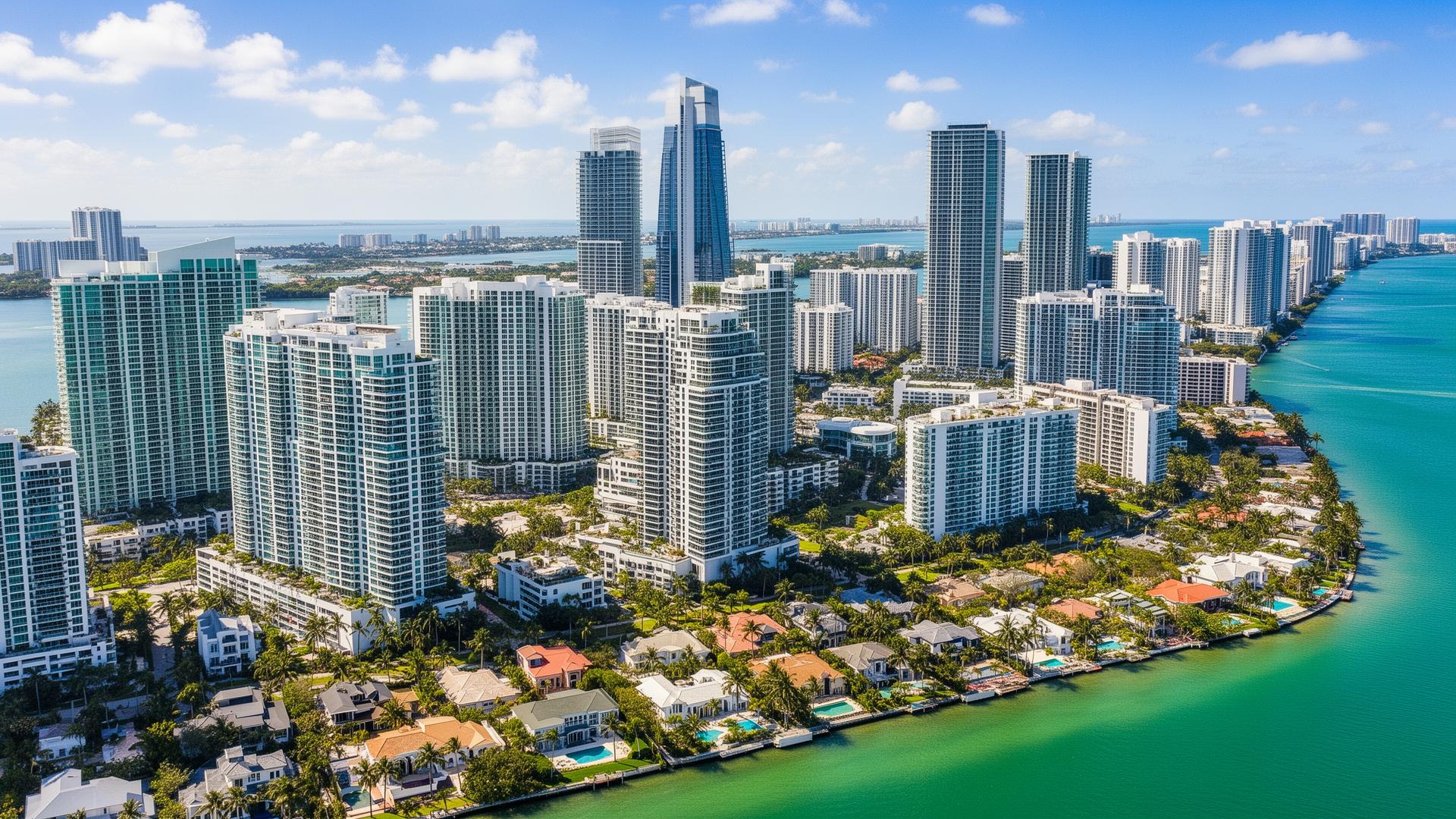
Miami Real Estate Market Forecast 2026: What Experts Predict
Last updated: July 2026
The short version of the Miami real estate market forecast 2026, drawn from named national and local forecasters: modest price growth, more transactions, and mortgage rates parked in the mid-6 percent range. Realtor.com's midyear update projects U.S. home prices rising just 1.2 percent in 2026 with existing-home sales at 4.10 million and mortgage rates averaging 6.3 percent [1]. NAR chief economist Lawrence Yun, as of June 2026, expects existing-home sales and the median price each to rise about 4 percent this year, with rates averaging 6.5 percent [2]. Freddie Mac's weekly survey put the 30-year fixed at 6.49 percent as of July 9, 2026 [3].
Locally, the data is already telling its own story. Miami-Dade posted its ninth consecutive month of year-over-year sales growth in May 2026, with the single-family median at $680,000, up 0.74 percent, and the condo median at $415,000, down 2.35 percent [4]. Zillow puts the average Miami home value at about $581,864, down 1.2 percent over the past year, and groups Miami with markets it expects to recover modestly rather than surge [5].
Here is what each forecaster predicts, and how it maps onto Miami's split market.
Where the 2026 forecasts agree
Across Realtor.com, NAR, and Zillow, three points of consensus stand out:
- Price growth below inflation nationally. Realtor.com cut its 2026 price forecast from 2.2 percent to 1.2 percent, which means roughly flat prices in real terms [1]. NAR is more constructive at 4 percent [2], but nobody credible is forecasting a boom.
- More transactions. Realtor.com sees existing-home sales edging up to 4.10 million [1], and NAR expects about a 4 percent sales increase with improvement concentrated in the second half [2]. Redfin's June data already showed U.S. sales at their highest pace since late 2022.
- No dramatic rate relief. Realtor.com models a 6.3 percent average [1], NAR 6.5 percent [2]. The forecast disagreement is measured in tenths, not points.
For Miami, that consensus implies a market that grinds rather than jumps: activity recovering, prices moving in low single digits, and segment selection mattering more than timing.
Mortgage rates: the swing variable
Freddie Mac's Primary Mortgage Market Survey averaged 6.49 percent for the 30-year fixed in the week of July 9, 2026, compared with 6.72 percent a year earlier [3]. That quarter-point improvement is why sales counts have been rising even without a headline rate drop.
The forecast band for the rest of 2026 is narrow: 6.3 percent (Realtor.com) to 6.5 percent (NAR) on average [1][2]. Two Miami-specific notes: first, this market is less rate-sensitive than most, since 38.7 percent of May closings were cash [4]. Second, if rates drift toward the low end of the band, the marginal effect shows up first in the financed segments, meaning single-family and townhouse product bought by local earners, not the cash-driven luxury and international segments.
Miami prices: what the mid-year data supports
MIAMI REALTORS' May 2026 report is the cleanest local read [4]:
- Single-family median: $680,000, up 0.74 percent year over year, on 5.2 months of supply
- Condo median: $415,000, down 2.35 percent, on 12.9 months of supply
- Total sales up 7.9 percent year over year, the ninth straight monthly gain
- Sales at $1 million and above up 14.7 percent
Zillow's valuation model, which blends all housing types, shows the average Miami home value down 1.2 percent over the past year at roughly $581,864 [5], consistent with a market where condo softness offsets single-family firmness. Zillow's 2026 outlook places Miami among markets expected to post modest growth as they recover from 2024-2025 declines rather than lead the country [5].
A reasonable synthesis for the balance of 2026: single-family prices flat to up low single digits, condo prices flat to down mid single digits with wide variation by building age and financial condition, and total transaction volume continuing to recover.
The condo and single-family split will define the year
Every forecast above is an average, and Miami's average conceals the most important dynamic: a seller's market and a buyer's market operating side by side [4]. Single-family supply fell 19 percent year over year to 5.2 months, while condos sit at 12.9 months, with older buildings carrying inspection, reserve, and insurance burdens that newer product does not.
Expect that gap to persist through 2026. The structural costs pressuring older condo buildings do not resolve in a single year, while single-family land in coastal Miami-Dade is not getting less scarce. Waterfront and coastal submarkets like Miami Beach illustrate both sides at once: strong demand for detached and new-construction product alongside heavy negotiating room in older condo lines.
One cost input did improve: Florida regulators approved an 8.7 percent average statewide rate decrease for Citizens Property Insurance taking effect from July 1, 2026 [6], the first broad reduction in roughly a decade. Insurance remains expensive here, but the direction turned, which supports both carry costs and buyer confidence at the margin.
What could move the forecast
- Rates breaking the band. A sustained move below 6 percent would pull financed demand forward faster than any forecaster currently models; a move back above 7 percent would stall the sales recovery.
- Insurance trajectory. Further rate filings in either direction feed directly into monthly carrying costs and condo association budgets.
- Condo inventory. If older-building owners list ahead of assessment deadlines faster than buyers absorb, months of supply could stretch further before clearing.
- Migration and international flows. South Florida drew $4.4 billion in foreign residential purchases in 2025, and that channel is a demand floor the national forecasts do not fully capture.
Positioning for 2026
If you are selling a single-family home, the data argues for confidence on price but realism on time: 5.2 months of supply supports value, but days on market have lengthened, so presentation and pricing discipline still decide outcomes. A grounded number is the starting point, and that is what a listing strategy conversation should produce.
If you are selling a condo, especially in an older building, the forecast argues for pricing to the current market rather than to a 2022 comp, and for having the association's documents organized before buyers ask.
If you are buying, the split market is an opportunity to be deliberate: negotiate hard in the condo segment, move decisively on well-priced single-family product, and underwrite insurance and association costs line by line. Mapping that to your budget and hold period is the work of a buyer consultation.
Frequently asked questions
Will Miami home prices drop in 2026?
The sourced forecasts point to divergence, not a broad drop. Single-family medians were still rising modestly as of May 2026 on tight supply, while condo medians were down 2.35 percent year over year [4]. National forecasters expect low single-digit price growth overall [1][2].
What will mortgage rates be for the rest of 2026?
The 30-year fixed averaged 6.49 percent in early July 2026 [3]. Realtor.com projects a 6.3 percent average for the year [1] and NAR projects 6.5 percent [2], so plan around the mid-6s rather than waiting on a big decline.
Is 2026 a good year to sell a Miami condo?
It is a competitive year to sell one. At 12.9 months of supply [4], correct pricing and complete building documentation are what separate sold listings from stale ones. Well-run newer buildings face materially less pressure than older stock.
Is Miami still a seller's market for houses?
By the supply measure, yes. Single-family months of supply stood at 5.2 in May 2026 with inventory down 19 percent year over year [4], which continues to favor sellers in that segment.
What do experts predict for Miami real estate beyond 2026?
Most named forecasts run one year out. The structural inputs, constrained single-family supply, ongoing condo-stock repricing, and steady migration and international demand, suggest the split-market pattern extends into 2027, but treat multi-year price predictions with skepticism.
Gabriel
Sources
- Realtor.com 2026 Forecast Update: Home Price Growth To Cool Further, Trailing Inflation (PR Newswire, 2026)
- NAR Chief Economist Lawrence Yun Says Home Sales Expected to Improve in Second Half of 2026, National Association of REALTORS (June 16, 2026)
- Primary Mortgage Market Survey, Freddie Mac (week of July 9, 2026)
- Miami-Dade Home Sales Rise for Ninth Consecutive Month, MIAMI REALTORS May 2026 statistics (PR Newswire, June 2026)
- Miami, FL Housing Market: Home Prices and Trends, Zillow (accessed July 2026)
- Citizens' 2026 Multiperil Rates to Drop Statewide, Citizens Property Insurance Corporation (March 2026)
Gabriel A. Moyers, PA. eXp Realty. Florida License #3407280. Equal Housing Opportunity. This article is general information as of July 2026 and is not legal, tax, or financial advice. Verify current figures against authoritative sources before acting.
Thinking of selling your luxury property in Miami? Find out what your home is worth.
Get Your Home ValuationLooking for your dream home in Miami? Take our personalized home search quiz.
Start Your Home Search Quiz