
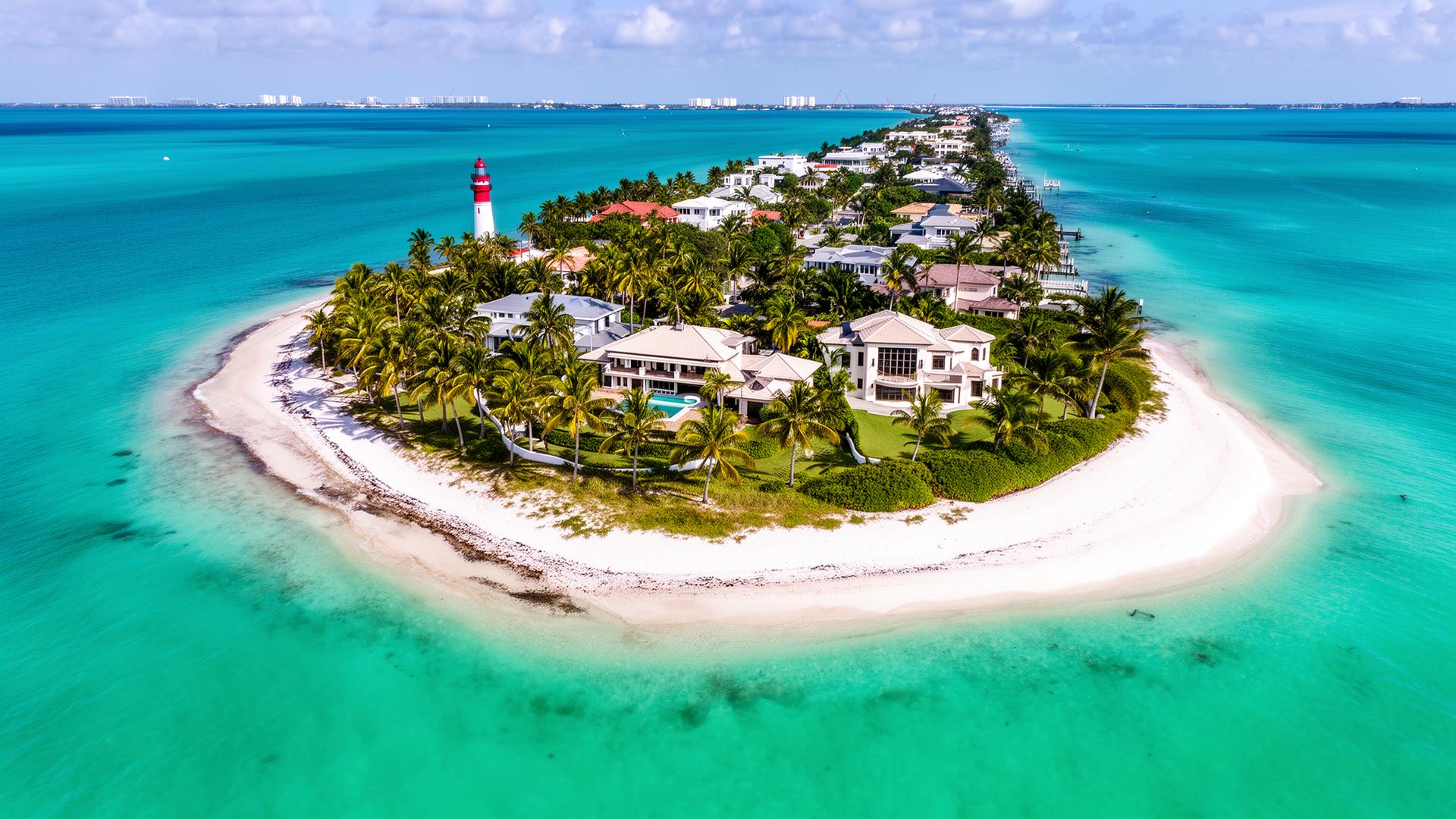
Key Biscayne Waterfront Living: An Island Buyer's Guide
Last updated: June 2026
Key Biscayne waterfront living means owning on a barrier island connected to mainland Miami by a single causeway, with the Atlantic Ocean on the east and Biscayne Bay on the west. It is a small, low-density municipality: the Village of Key Biscayne incorporated in 1991 and had a population of 14,809 at the 2020 census, sitting on roughly 1.25 square miles of land [1]. For buyers, the island trades a wider mainland inventory for a defined supply, direct water access, and a park-bounded setting (Crandon Park to the north, Bill Baggs Cape Florida State Park to the south) [1].
The price of entry reflects that scarcity. As of May 2026, the median home sale price in Key Biscayne was about $1.4 million, with waterfront and new condo product running well above that line [2]. Two costs shape the underwriting more than the headline price: flood insurance, which is effectively mandatory here because the island sits in a coastal flood hazard area, and property taxes, which reset to full market value when a home changes hands. This guide covers the geography, the recent market as of mid-2026, and the carrying-cost math, with sources for every figure.
If you are weighing a purchase, a buyer consultation is the place to map a specific building or street against your budget. If you already own here and want a current read, request a listing valuation.
What makes Key Biscayne a distinct waterfront market
Key Biscayne is an island, not a mainland neighborhood, and that single fact drives most of its market behavior. The Village is bordered on the north by Crandon Park, on the south by Bill Baggs Cape Florida State Park, on the east by the Atlantic Ocean, and on the west by Biscayne Bay [1]. Access is by the Rickenbacker Causeway, which also connects Virginia Key, the University of Miami's Rosenstiel School, and the Miami Marine Stadium before reaching the island [3].
Two consequences follow for buyers:
- Defined supply. With about 1.25 square miles of land and large protected parks at both ends, the island cannot expand outward [1]. New supply comes from redevelopment and a limited condo pipeline, not from greenfield sprawl.
- Real water access on two sides. Bay-side homes and docks face Biscayne Bay; ocean-side condos and beach access face the Atlantic. "Waterfront" on Key Biscayne can mean either exposure, and they price and insure differently.
This is the underwriting lens that matters: you are buying into a fixed-footprint island, so the durable question is carrying cost over a hold period, not just the entry price.
Key Biscayne market snapshot (as of May 2026)
The island is a higher-priced, slower-moving segment of the Miami market. As of May 2026, the median sale price in Key Biscayne was approximately $1.4 million, with homes taking meaningfully longer to sell than a year earlier [2]. Waterfront houses and newer condo inventory carry list prices well above the overall median, which is why a single islandwide number understates what a turnkey bay-front or oceanfront unit actually costs [2].
A few practical takeaways from the current data:
- Use the median sale price, not the median list price, when you sanity-check an offer. List prices on the island skew high because of luxury and waterfront product still sitting on the market.
- Days on market has lengthened versus a year ago, which generally favors buyers who are patient and willing to write conditioned offers [2].
- Condo and single-family dynamics diverge. If you are comparing a bay-front house to an oceanfront condo, treat them as two different markets with different supply.
Market figures move. For a building-specific or street-specific read rather than an islandwide median, see Miami luxury homes for sale or ask for a current comparative analysis.
The two parks that bound the island
Much of Key Biscayne's appeal is that it cannot be built wall to wall. Crandon Park, on the north end, is a Miami-Dade County park of several hundred acres with public beach, a marina, and recreation areas. Bill Baggs Cape Florida State Park occupies the southern tip, protecting coastal habitat, more than a mile of Atlantic beachfront, and the historic Cape Florida Lighthouse [3]. Together they bookend the residential core and are a structural reason the island stays low-density.
For a buyer, the parks are not a lifestyle footnote. They are why the supply is constrained, why beach and bay access stay public and open, and why a meaningful share of the island will never convert to housing.
Carrying costs: flood insurance and property taxes
The two line items that most often surprise out-of-state buyers are flood insurance and the property-tax reset at sale. Both are knowable in advance, and both belong in your underwriting before you write an offer.
Flood insurance is effectively required here
Key Biscayne is a coastal barrier island, and properties in a Special Flood Hazard Area generally need flood coverage. Under Florida law (Section 627.715, Florida Statutes), Citizens Property Insurance Corporation is phasing in a flood-insurance requirement for most personal residential policies that carry wind coverage. The schedule reached homes with dwelling coverage of $400,000 or more on January 1, 2026, and extends to all qualifying policies on January 1, 2027 [4]. Homes located in a Special Flood Hazard Area must carry flood insurance regardless of dwelling value [4]. Flood is a separate policy from your homeowners coverage, so budget it as its own annual line.
Property taxes reset when you buy
Florida's Save Our Homes provision caps annual increases in the assessed value of a homesteaded property at 3% or the change in the Consumer Price Index, whichever is lower. For 2026, that cap is 2.7% [5]. The catch for buyers: the cap resets at sale. When a homesteaded property sells, the new owner's first-year assessed value is set to full market (just) value, and the cap begins accumulating from there [5]. A long-time owner's low tax bill does not transfer to you, so estimate your taxes from the purchase price, not from the seller's current bill.
If you are running the numbers on a specific home, a buyer consultation can pull the flood zone designation and a realistic post-sale tax estimate before you commit.
Frequently asked questions
What is the median home price on Key Biscayne?
As of May 2026, the median home sale price in Key Biscayne was approximately $1.4 million [2]. Waterfront houses and newer condos typically price above that islandwide median, so use it as a floor for the broader market rather than a target for premium product [2].
Is flood insurance required on Key Biscayne?
In practice, yes for most owners. The island is a coastal barrier island, and under Section 627.715, Florida Statutes, Citizens policyholders with wind coverage are subject to a phased flood-insurance requirement that reached $400,000-and-up dwellings on January 1, 2026, and all qualifying policies on January 1, 2027. Homes in a Special Flood Hazard Area must carry flood coverage regardless of dwelling value [4].
Will my property taxes match the seller's current bill?
No. Florida's Save Our Homes cap (2.7% for 2026) limits annual assessment increases for the current owner, but it resets at sale. Your first-year assessed value is set to full market value, so budget taxes from your purchase price rather than the seller's existing bill [5].
When did Key Biscayne become its own municipality?
The Village of Key Biscayne incorporated in 1991. Its population was 14,809 at the 2020 census [1].
Does Key Biscayne have public beach access?
Yes. The island is bounded by Crandon Park to the north and Bill Baggs Cape Florida State Park to the south, both of which provide public beach and recreation areas along with the historic Cape Florida Lighthouse [1][3].
Working the island as a buyer or seller
Key Biscayne rewards specificity. The right question is rarely "what does the island cost," it is "what does this building or this bay-front lot cost to own over my hold period, after flood insurance and a tax reset." If you are buying, start with a buyer consultation. If you are selling, a current listing valuation or the sell your Miami home page is the place to begin.
If you want a building-by-building read or a carrying-cost estimate on a specific address, reach out and I will put the numbers together.
Gabriel
Sources
- U.S. Census Bureau / Wikipedia, "Key Biscayne, Florida" (incorporation 1991, 2020 population 14,809, land area, bordering parks) — https://en.wikipedia.org/wiki/Key_Biscayne,_Florida
- Redfin, "Key Biscayne Housing Market: House Prices & Trends" (median sale price ~$1.4M, days on market, as of May 2026) — https://www.redfin.com/city/9243/FL/Key-Biscayne/housing-market
- Florida State Parks / Florida Rambler, "Bill Baggs Cape Florida State Park" and Wikipedia "Rickenbacker Causeway" (parks, beachfront, lighthouse, causeway access) — https://www.floridastateparks.org/parks-and-trails/bill-baggs-cape-florida-state-park
- Citizens Property Insurance Corporation, "Flood" (Section 627.715, F.S.; phased requirement, $400,000 threshold Jan 1 2026, SFHA rule) — https://www.citizensfla.com/flood
- Florida Department of Revenue / Miami-Dade Property Appraiser, "Save Our Homes" (3% or CPI cap, 2.7% for 2026, reset at sale) — https://www.miamidadepa.gov/pa/benefit/save-our-homes.page
Gabriel A. Moyers, PA. eXp Realty. Florida License #3407280. Equal Housing Opportunity. This article is general information as of June 2026 and is not legal, tax, or financial advice. Verify current figures against the U.S. Census Bureau, Redfin, Citizens Property Insurance Corporation, and the Miami-Dade Property Appraiser before acting.
Thinking of selling your luxury property in Miami? Find out what your home is worth.
Get Your Home ValuationLooking for your dream home in Miami? Take our personalized home search quiz.
Start Your Home Search Quiz