
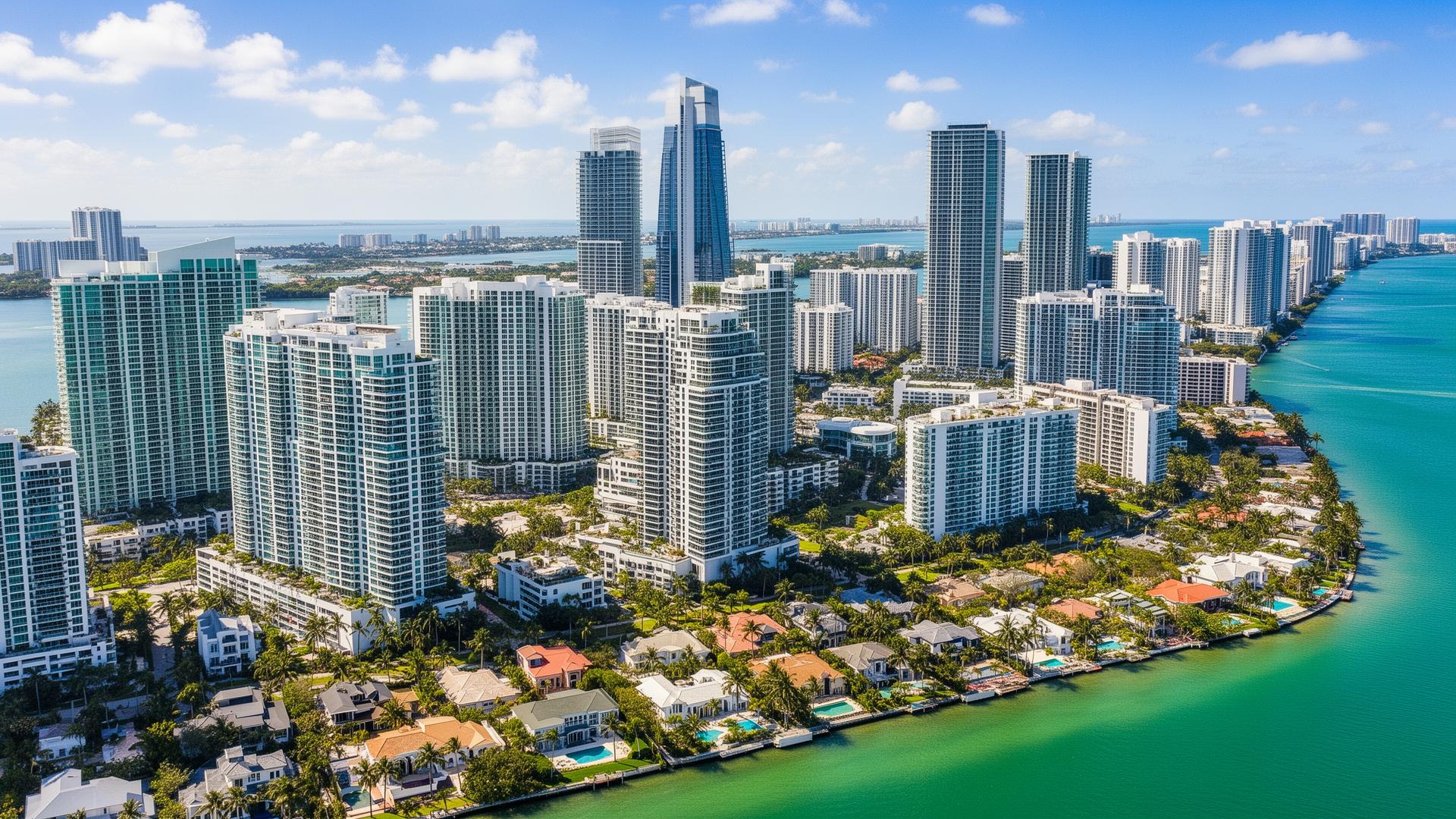
Miami real estate and rate stabilization in 2026
How does mortgage rate stabilization affect Miami real estate in 2026? In practical terms, it has replaced guesswork with a known cost of capital. As of the Freddie Mac Primary Mortgage Market Survey for the week of July 2, 2026, the average 30-year fixed rate was 6.43%, down from 6.67% a year earlier [1]. That is a narrow band compared with the swings of 2022 and 2023, and a narrow band is what lets buyers, sellers, and lenders underwrite deals with confidence. When the rate stops moving, the conversation shifts from timing the market to pricing the asset, and that is the biggest change I am seeing on the ground in Miami-Dade this year.
Last updated: July 2026
What "stabilization" actually means for your numbers
Rate stabilization does not mean cheap money. It means a predictable cost of borrowing. The Freddie Mac 30-year average has held in a tight range through the first half of 2026, ending at 6.43% for the week of July 2 [1]. Forecasters expect that range to persist: the Mortgage Bankers Association projects the 30-year fixed to average roughly 6.5% across 2026 [2], while Fannie Mae's outlook has projected rates drifting toward the high-5% area by the end of the year [3]. Treat both as sourced projections, not promises. The useful takeaway is that no major forecaster is calling for a return to 3% financing, so any purchase or sale decision should pencil out at today's rate, not a hoped-for future one.
For a buyer, a stable rate means your monthly payment on a given loan amount is a fixed input you can plan around. For a seller, it means the pool of qualified buyers is steady rather than shrinking week to week.
The lock-in effect is thawing, not gone
For two years, owners holding sub-4% mortgages had little reason to sell into a 7% market. As the spread between held rates and market rates narrows, that friction eases. It has not disappeared. A homeowner with a 3.5% note still gives up a cheap loan when they move, but life events such as relocation, downsizing, and estate planning increasingly outweigh rate arbitrage.
You can see the effect in inventory. In Miami-Dade, single-family active listings actually fell about 19% year over year as of May 2026, from roughly 5,687 to 4,599 [4], so single-family supply remains tight even as rates stabilize. The condo side tells the opposite story, with far more standing inventory, which is why the two property types are behaving differently this year.
Miami-Dade prices are flat to modestly higher, by property type
Stabilized rates have not produced uniform price moves. The market has split by asset class:
- Single-family homes held their value. The MIAMI Association of Realtors reported a Miami-Dade single-family median sale price of $680,000 in May 2026, up 0.74% year over year [4].
- Condominiums softened. The existing-condo median was $415,000 in May 2026, down 2.35% year over year [4], reflecting elevated condo inventory and higher carrying costs tied to assessments and insurance.
- Metro-wide, the FHFA House Price Index for the Miami-Miami Beach-Kendall division showed roughly 4.37% annual appreciation through the first quarter of 2026 [5], a moderate pace well below the double-digit years of 2021 and 2022.
If you want a defensible read on your own property rather than a metro average, start with a listing valuation that reflects recent closings in your immediate radius.
Is this still a seller's market?
It depends on what you own. Tight single-family supply keeps well-priced, move-in-ready houses in a seller-favorable position. The condo segment has tilted toward buyers, with more standing inventory and longer marketing times. Redfin data for the city of Miami showed homes averaging about 113 days on market in 2026, up from roughly 100 a year earlier [6], which tells you buyers have more room to negotiate than they had during the 2021 rush.
Neighborhood matters as much as property type. Established single-family markets such as Coral Gables and Pinecrest behave differently from condo-heavy corridors. Averages hide those differences, so underwrite the specific submarket you are transacting in.
Strategy for buyers in a stable-rate market
With rates range-bound, the advantage shifts from speed to selection. Financing and appraisal contingencies that buyers routinely waived in 2021 are back on the table. Some sellers will fund a rate buy-down or closing-cost credit to close a qualified buyer, which can lower your effective rate more than shopping lenders for an eighth of a point.
Get your financing sorted before you tour. A buyer consultation to define budget, target submarkets, and financing structure will do more for your outcome than watching the daily rate ticker.
Strategy for sellers
Price to the current comparable set, not to last cycle's peak. With buyers underwriting at 6.43% [1] and taking their time, an overpriced listing sits and then trades below where a correctly priced one would have. Condition and pricing carry the sale now, not urgency. Review recent closings in your building or block before you set a number, and read more market breakdowns on the blog.
How stable rates change the math on a monthly payment
The practical value of a rate that holds still is that it removes a moving variable from your budget. When the 30-year fixed swung from roughly 3% to over 7% between 2021 and 2023, a buyer who toured a home one month could be priced out of the same home the next, purely from payment shock. With the Freddie Mac average at 6.43% for the week of July 2, 2026 [1], the payment on a given loan amount is knowable, and it stays knowable long enough to shop, tour, and negotiate without the number moving under you.
That predictability is worth more than a small rate decline to most buyers. It lets you set a firm price ceiling, structure your offer around a fixed carrying cost, and know that a delay of a few weeks will not blow up your qualification. It also lets sellers price with confidence that the buyer pool is not evaporating between listing and contract.
What to watch for the rest of the year
Three inputs will drive the local market from here, and all three are worth tracking against named sources rather than sentiment. The first is the direction of the 30-year fixed, which the MBA projects near 6.5% for 2026 [2] and Fannie Mae has projected easing toward the high-5% range by year-end [3]. The second is single-family inventory, which was still tight in May 2026 at roughly 4,599 active listings, down about 19% year over year [4]. If that number climbs, single-family pricing loses some of its support. The third is the condo segment, where higher carrying costs continue to pressure values [4]. Reading these three together gives you a clearer picture than any single headline.
Frequently asked questions
What is the current 30-year mortgage rate in 2026?
The Freddie Mac PMMS reported a 30-year fixed average of 6.43% for the week of July 2, 2026, down from 6.67% a year earlier [1]. Your quoted rate will vary with credit, loan size, and structure.
Are Miami home prices rising or falling in 2026?
It depends on property type. Single-family median price in Miami-Dade was up 0.74% year over year in May 2026, while the existing-condo median was down 2.35% [4]. The metro-wide FHFA index showed about 4.37% annual appreciation through Q1 2026 [5].
Will mortgage rates drop later in 2026?
Forecasts vary. The MBA projects roughly 6.5% for 2026 [2], while Fannie Mae has projected rates easing toward the high-5% range by year-end [3]. These are projections, not guarantees, so plan at today's rate.
Does rate stabilization make it a better time to buy?
It makes underwriting more predictable and restores contingencies and negotiating leverage that were rare during the 2021 rush. Whether it is right for you depends on your finances and how long you plan to hold.
Gabriel
Sources
- Freddie Mac Primary Mortgage Market Survey
- Mortgage Bankers Association, Forecasts and Commentary
- Fannie Mae, Mortgage Rates Expected to Move Below 6 Percent by End of 2026
- MIAMI Association of Realtors, Miami-Dade monthly statistical reports
- FHFA House Price Index Summary Tables
- Redfin, Miami Housing Market
Gabriel A. Moyers, PA. eXp Realty. Florida License #3407280. Equal Housing Opportunity. This article is general information as of July 2026 and is not legal, tax, or financial advice. Verify current figures against authoritative sources before acting.
Thinking of selling your luxury property in Miami? Find out what your home is worth.
Get Your Home ValuationLooking for your dream home in Miami? Take our personalized home search quiz.
Start Your Home Search Quiz