
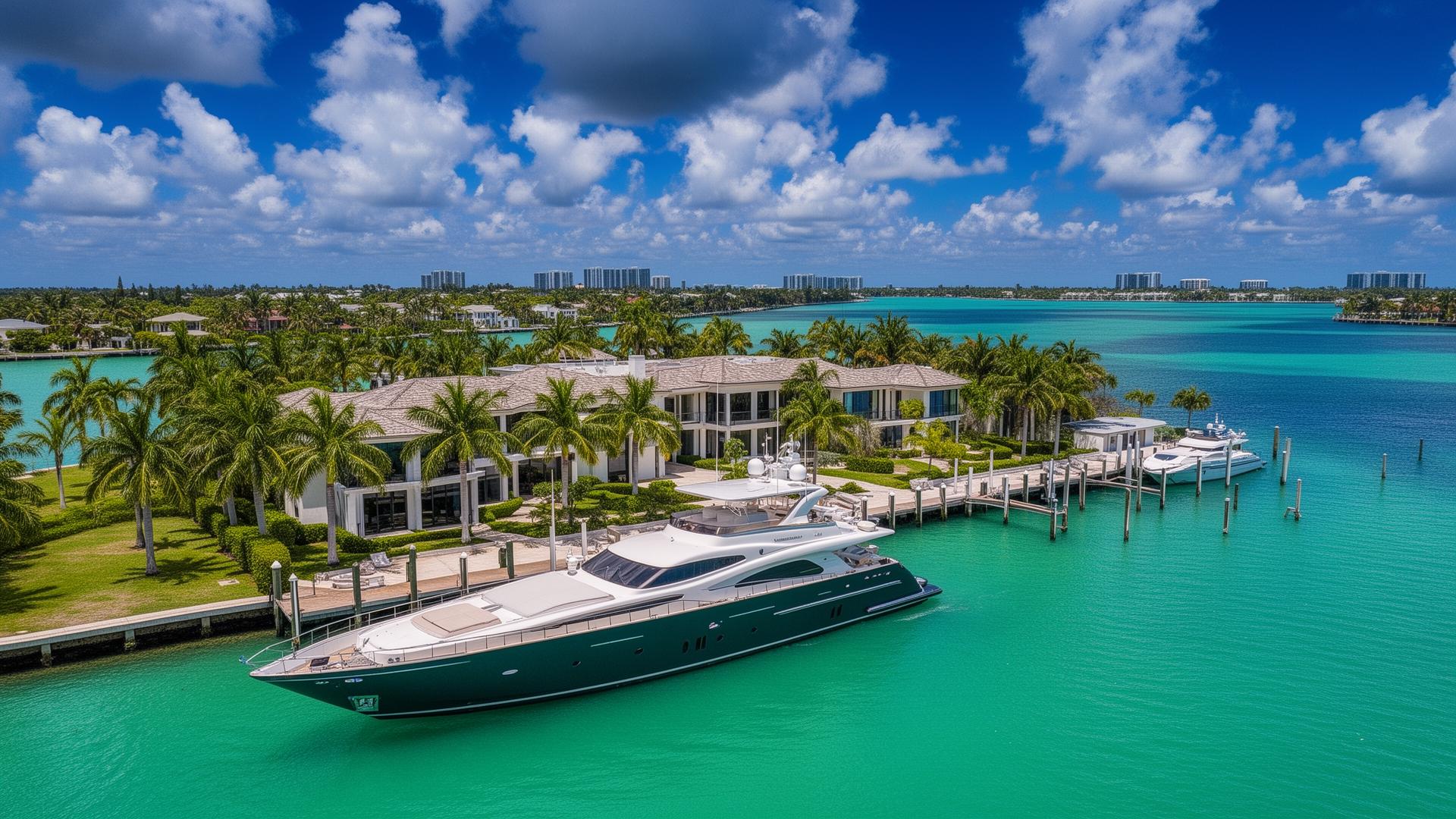
Miami Deep Water Dock Homes: A Buyer's Guide to Draft, Bridges, and Permits
Last updated: June 2026
Buying a Miami deep water dock home comes down to four questions you should answer before you write an offer: how much draft the basin holds at low tide, whether your vessel clears the fixed bridges between the dock and the ocean, what condition the seawall is in, and whether the dock itself is permitted. Get those four right and the dock is an asset. Get them wrong and you have bought a slip your boat cannot use. The single hardest constraint in Miami is the Julia Tuttle Causeway bridge, which has a fixed vertical clearance of 56 feet, lower than the 65-foot standard used on the rest of the Atlantic Intracoastal Waterway [1]. A sailboat or sportfish that needs more than 56 feet of air draft cannot reach a dock north of that bridge from the inland route and has to run outside through Government Cut instead. This guide walks the underwriting in order, so you can price the dock the way a marine surveyor and a lender would, not the way a listing photo invites you to.
If you want help mapping a specific address against these constraints, a buyer consultation is the place to start. You can also browse current Miami luxury homes for sale to see what is on the water.
What "deep water" actually means in Miami
"Deep water" is a marketing term, not a measured one, so treat it as a claim to verify rather than a fact. What matters is the controlling depth: the shallowest point along the full path your vessel travels from the dock to open water, measured at mean low water. A dock can sit in eight feet of water and still be useless if there is a three-foot shoal between the basin and the channel.
Ask the seller for a recent bathymetric survey or hire one, and match the controlling depth against your vessel's draft plus a margin for tide and squat. Biscayne Bay tides are modest, but a foot of swing can be the difference between a clean exit and a grounded keel at low tide. If the home is on a canal rather than the open bay, confirm the canal has been dredged recently and ask who holds the dredge permit, because re-dredging is permitted work, not a weekend project.
Fixed bridges decide where your boat can go
Air draft is the constraint buyers underestimate most. Every fixed bridge on your route imposes a hard ceiling on vessel height, and that ceiling does not move.
Most fixed bridges crossing the channel of the Atlantic Intracoastal Waterway in Florida clear 65 feet above mean high water [1]. The exception, and the one that shapes the entire north Miami market, is the Julia Tuttle Causeway bridge near Intracoastal Mile 1087.2, which clears 56 feet [1]. If your vessel's air draft exceeds 56 feet, you cannot pass under the Julia Tuttle on the inland route; vessels bound for Miami have to leave the Intracoastal and run the coast outside [1].
The practical takeaway: a dock's value depends on where it sits relative to that bridge and to the nearest ocean inlet. A tall sailboat berthed north of the Julia Tuttle is functionally landlocked from the inland waterway. Before you fall for a basin, map the exact route from the dock to the inlet you plan to use and check the clearance of every fixed bridge along it.
Seawalls are the expensive surprise
The seawall is the part of a waterfront property that fails quietly and costs the most to fix. A leaning cap, voids behind the wall, rusted tie-backs, or cracking are signs the wall is at or past the end of its service life, and full replacement on a typical residential lot runs well into six figures.
Treat the seawall like a roof or a foundation: get its age, get its last inspection, and price a replacement reserve into your offer if the condition is uncertain. Two things make seawall work slower and more expensive in Miami-Dade than a buyer expects. First, replacing or capping a seawall is regulated marine construction. Second, the wall usually sits at the boundary of state-owned submerged land, which adds a layer of consent on top of the local permit. Both are covered below.
Dock and seawall permits in Miami-Dade
Docks and seawalls are permitted structures, and an unpermitted one is a liability you inherit at closing, not a feature.
In Miami-Dade County, a Class I permit must be obtained before performing work in, on, over, or upon tidal waters or coastal wetlands, including the construction or replacement of docks and seawalls and the installation of boatlifts, davits, and mooring pilings [2]. Most submerged land beneath Biscayne Bay is owned by the State of Florida, so consent to use that land is required before building over it; the county's Department of Regulatory and Economic Resources has been delegated authority to grant that consent when a project meets the applicable standards [3].
At the state level, Florida law exempts certain small private docks from a Department of Environmental Protection permit. Under Florida Statute 403.813(1)(b), a private dock of 1,000 square feet or less of over-water surface area in most waters (or 500 square feet or less in Outstanding Florida Waters) can be exempt, provided it is built on pilings or floats without dredging or filling, is for non-commercial recreational use, and does not create a navigational hazard [4]. The exemption is for the state permit only. It does not remove the need for the county Class I permit or for submerged-land consent.
What this means for a buyer: ask for the dock and seawall permits in writing during due diligence. If the structure is larger than the exemption or was built without the county permit, you may be the one who has to bring it into compliance, and after-the-fact permitting is slower and more expensive than getting it right the first time.
Underwriting the carrying cost: insurance and flood
A deep water dock home is a wind-and-flood asset, and the carrying cost belongs in your model before you fall in love with the view.
Citizens Property Insurance, Florida's insurer of last resort, does not cover flood damage; a separate flood policy is required. As of January 2026, Citizens requires flood coverage for many personal residential wind policies with a dwelling (Coverage A) value of $400,000 or more, even outside the mapped flood hazard area, with the requirement phasing in until all such policies must carry flood coverage by January 2027 [5]. Most waterfront homes sit in or near a Special Flood Hazard Area, where flood coverage has been required for longer.
Price the wind premium, the flood premium, the deductibles (named-storm deductibles are typically a percentage of the dwelling value, not a flat dollar amount), and a seawall reserve into your annual carrying cost. On a waterfront property, those line items separate a sound buy from an overpay.
A buyer's due-diligence checklist
Work this list in order before you remove contingencies:
- Controlling depth. Bathymetric survey from dock to open water, measured at mean low water, matched to your vessel's draft.
- Air draft. Clearance of every fixed bridge on your route to the inlet, including the 56-foot Julia Tuttle Causeway [1].
- Seawall. Age, last inspection, condition of cap and tie-backs, replacement reserve if uncertain.
- Permits. Written dock and seawall permits, county Class I permit, and submerged-land consent where applicable [2][3][4].
- Insurance. Bound wind and flood quotes, deductibles, and the flood requirement that applies at your price point [5].
- Boat fit. Slip length, beam, and lift capacity rated to your actual vessel, not the one in the brochure.
Frequently asked questions
What is the lowest fixed bridge for boats in Miami?
The Julia Tuttle Causeway bridge, near Intracoastal Mile 1087.2, has a fixed vertical clearance of 56 feet, lower than the 65-foot standard found on the rest of Florida's Atlantic Intracoastal Waterway [1]. Vessels taller than 56 feet cannot pass under it on the inland route and run the coast outside instead.
Do I need a permit to build or replace a dock in Miami-Dade?
Yes. A Miami-Dade Class I permit is required before constructing or replacing docks and seawalls in tidal waters [2], and consent is required to build over state-owned submerged land in Biscayne Bay [3]. Separately, Florida exempts some small private docks (1,000 square feet or less in most waters) from the state DEP permit, but that exemption does not replace the county permit [4].
Is flood insurance required on a Miami waterfront home?
Often, yes. Citizens requires flood coverage for many wind policies with a dwelling value of $400,000 or more as of January 2026, and flood coverage has long been required inside the mapped Special Flood Hazard Area where most waterfront homes sit [5]. Citizens does not cover flood damage itself, so a separate policy is needed.
How much does a deep water dock add to a home's value?
There is no fixed premium, because the value depends on the constraints in this guide: controlling depth, bridge clearance to your inlet, seawall condition, and whether the dock is permitted. A permitted, deep, unrestricted dock that fits your vessel is worth far more than a "deep water" label on a basin your boat cannot reliably use. Price the dock on what it actually delivers.
Can a sailboat reach a dock north of the Julia Tuttle bridge?
Only if its air draft is under 56 feet on the inland route, or by running the coast outside through an ocean inlet [1]. This is why air draft, not just water depth, decides which docks are usable for taller vessels.
Sources
- Waterway Guide / Florida Inland Navigation District, Julia Tuttle Causeway Bridge listing and Atlantic ICW bridge clearances — https://www.waterwayguide.com/bridge/3-150/julia-tuttle-causeway-bridge
- Miami-Dade County, Class I Permit Application for Coastal Construction — https://www.miamidade.gov/permits/library/class-1-package.pdf
- Miami-Dade County, One-Time Environmental Permits (submerged-lands consent and RER delegated authority) — https://www.miamidade.gov/permits/environmental-one-time.asp
- The 2025 Florida Statutes, Section 403.813 (private dock permit exemptions) — https://www.leg.state.fl.us/Statutes/index.cfm?App_mode=Display_Statute&URL=0400-0499%2F0403%2FSections%2F0403.813.html
- Citizens Property Insurance Corporation, Flood Insurance Requirements — https://www.citizensfla.com/flood
If you are weighing a specific waterfront home, I am happy to walk the dock, the seawall, and the permit file with you before you commit. You can start with a buyer consultation, and if you are also selling a Miami home to fund the move, a listing valuation will tell you what your current property supports.
Gabriel
Gabriel A. Moyers, PA. eXp Realty. Florida License #3407280. Equal Housing Opportunity. This article is general information as of June 2026 and is not legal, tax, or financial advice. Verify current dock, seawall, and permit requirements with Miami-Dade County RER and the Florida Department of Environmental Protection, and confirm insurance requirements with Citizens Property Insurance, before acting.
Thinking of selling your luxury property in Miami? Find out what your home is worth.
Get Your Home ValuationLooking for your dream home in Miami? Take our personalized home search quiz.
Start Your Home Search Quiz