
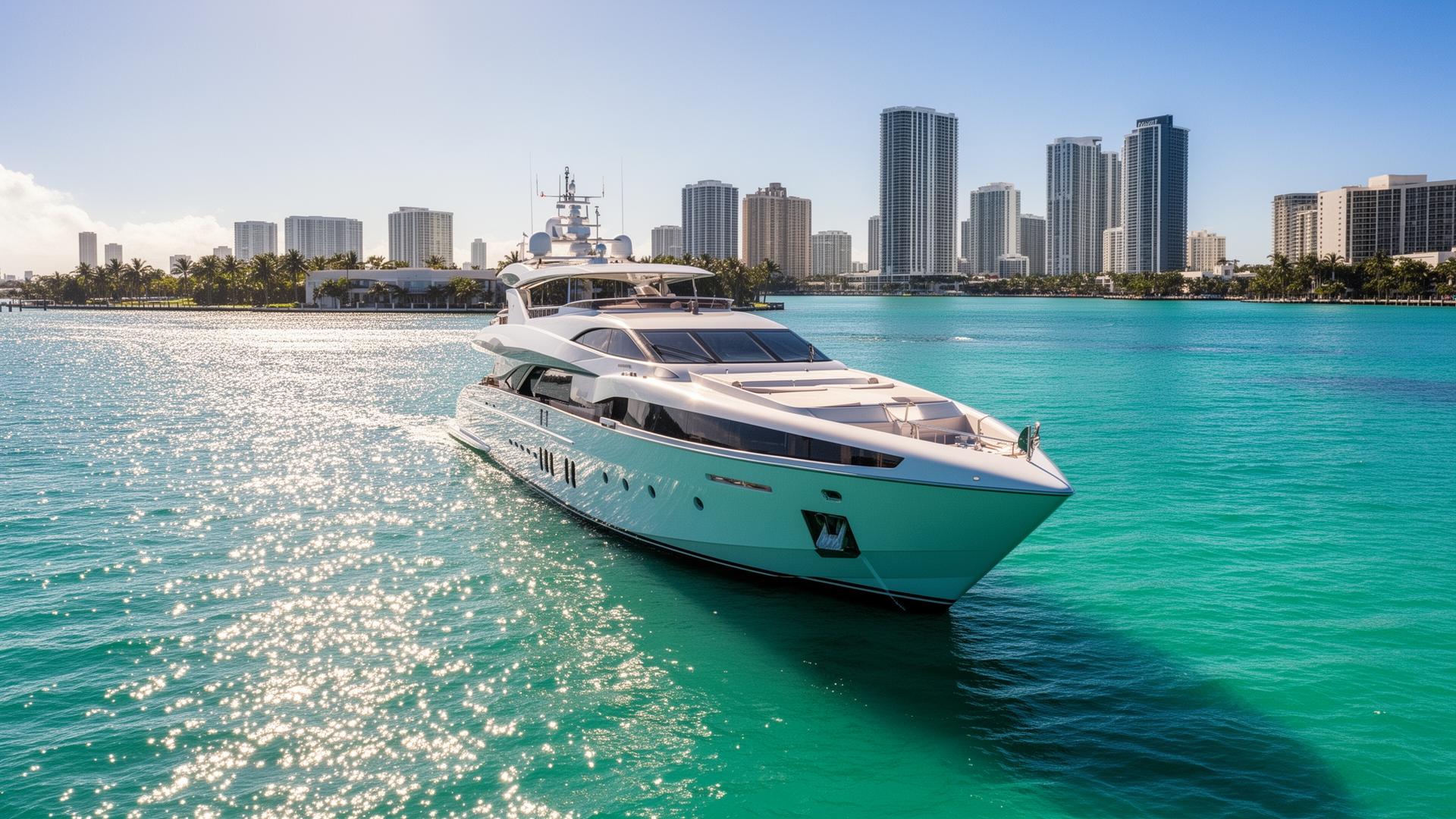
Miami Neighborhoods for Yacht Owners: Deep-Water Access by Area
Last updated: June 2026
If you keep a yacht at home, the right Miami neighborhood is the one whose dock matches your vessel's draft and air draft, not the one with the prettiest listing photos. For larger boats, the short list usually comes down to four areas: Indian Creek (perimeter deep-water docks behind a single bascule bridge), Sunset Islands (deep water off most outer homes, with bridge timing to reach Government Cut), Coconut Grove (no-fixed-bridge channels at Grove Isle and Hughes Cove), and Key Biscayne (protected bay frontage, but the Rickenbacker Causeway fixed bridge limits air draft for sailing yachts and tall motor yachts). The deciding factors are channel depth at mean low water, whether any bridge between your slip and the ocean is fixed or opening, and how far you run before you reach an inlet. This guide walks each area through that lens and pairs it with current market data, so you can underwrite a waterfront purchase the way you would any other asset.
Miami neighborhoods for yacht owners reward the same diligence you would apply to a slip lease: measure first, fall in love second.
How to read a waterfront neighborhood as a yacht owner
Before any single area matters, three numbers decide whether a dock fits your boat.
- Draft vs. channel depth at mean low water (MLW). A 7-foot channel will not float a vessel that draws 8 feet at low tide, regardless of how deep the slip is. Ask for the surveyed MLW depth of the channel, not just the dock.
- Air draft vs. bridge clearance. A fixed bridge has a permanent vertical clearance. A bascule (opening) bridge can let tall vessels through, but on a schedule. The 63rd Street Bridge over Indian Creek, for example, is a double-leaf bascule with about 11 feet of clearance closed, so taller boats wait for an opening. [1]
- Run time to an inlet. Distance to Government Cut or Haulover Inlet, plus the number of opening bridges in between, sets how spontaneous your ocean runs can be.
Get those three right and the neighborhood differences below become straightforward trade-offs rather than surprises.
Indian Creek: perimeter deep-water docks, one bascule bridge
Indian Creek Village is a private island where homes sit on the perimeter with direct frontage and private docks, many sized for large yachts. [1] The single bridge connecting the village to the mainland is the 63rd Street Bridge, a bascule structure with roughly 11 feet of vertical clearance in the closed position and a 50-foot horizontal opening. [1] For most motor yachts that clearance is a non-issue at idle; for sailing yachts or vessels with tall hardtops, you plan around bridge openings.
The underwriting takeaway: Indian Creek offers among the most accommodating at-home dockage in the area for large vessels, with the trade-off being a small, tightly controlled inventory. If your boat fits the perimeter docks and you want bay-and-ocean access close to home, it belongs on the list.
Sunset Islands: deep water off the outer homes, bridge timing to the south
The Sunset Islands are four connected islands in Miami Beach, with deep-water access from most homes around the outer edges. [2] You sit close to the Intracoastal Waterway, which shortens repositioning time and makes northbound runs toward Haulover Inlet relatively direct. [2]
The constraint is southbound. To reach Government Cut and the open Atlantic to the south, you clear the Venetian Causeway bascule bridges, which carry limited closed clearance (roughly 8 to 10 feet) and open on a published schedule. [2] For a center-console or sport yacht that means waiting for an opening on busy weekends; for a tall vessel it is a planning factor on every southbound trip. When comparing two Sunset Islands docks, focus on the surveyed MLW depth at the dock, the exact channel distance to the Intracoastal, and any tight turns to open water. [2]
Coconut Grove: no-fixed-bridge channels for the largest vessels
Coconut Grove is the answer when air draft is the binding constraint. Grove Isle's marina reaches Biscayne Bay and the ocean through a channel with no fixed bridges, and the dockage there is built for large vessels, including superyachts. [3] Nearby, Hughes Cove is a small gated enclave built around a private boat basin with canal-to-bay access and no fixed-bridge restrictions. [3]
For a yacht owner, "no fixed bridge between my slip and the ocean" is the single most valuable phrase in a listing, because it removes air draft from the equation entirely. The trade-off in the Grove is channel depth: confirm the surveyed MLW depth against your draft, since some Grove channels run shallower than the open bay. [3] If you draw deep and stand tall, this is the area to study first.
Key Biscayne: protected bay frontage behind a fixed bridge
Key Biscayne offers protected Biscayne Bay frontage and quick access to the bay's open water, with established marinas such as the Key Biscayne Yacht Club and Rickenbacker Marina on the corridor. [4] The structural caveat is the Rickenbacker Causeway, which is a fixed bridge. [4] For low-profile motor yachts that is rarely a problem; for sailing yachts and tall-hardtop vessels, the fixed clearance can rule the area out, so verify your air draft against the causeway's published clearance before you fall for a view.
Key Biscayne earns its place for owners of vessels that comfortably pass under the causeway and who value protected, bay-facing dockage close to open water. It is the area where the "fixed vs. opening bridge" distinction matters most.
What waterfront access costs in the 2026 Miami market
Waterfront with real dockage trades at a premium to inland product, and the broader market sets the floor. As of May 2026, the Miami-Dade single-family median sale price was $680,000, up 0.74% year over year. [5] The strength is concentrated at the top: sales of Miami properties priced at $1 million and above climbed 14.7% from a year earlier as of May 2026, which is the band most deep-water yacht-owner homes occupy. [5]
One structural reason that demand holds: Florida levies no individual income tax, a prohibition written into Article VII, Section 5 of the Florida Constitution and confirmed in the Tax Foundation's 2026 state data. [6] That changes the after-tax math of relocating for buyers leaving higher-tax states, and it shows up in the cash-heavy, $1 million-plus segment where waterfront sits. If you are weighing what a specific dock-equipped home should trade for, a current comparative analysis on your target block is more useful than any countywide median. You can start one through a listing valuation, or browse active inventory among Miami luxury homes for sale.
Matching the neighborhood to your vessel
Run the decision in this order:
- Air draft first. Tall vessel or sailing yacht: weight Coconut Grove's no-fixed-bridge channels, and treat Key Biscayne's fixed causeway and Sunset Islands' southbound bascules as constraints to verify.
- Then draft vs. channel depth. Deep-draft boat: confirm surveyed MLW depth in the Grove and on any specific Indian Creek or Sunset Islands dock before committing.
- Then run time and lifestyle. If most of your running is northbound to Haulover, Sunset Islands' Intracoastal proximity is a real advantage; if you want maximum at-home flexibility for a large motor yacht, Indian Creek and the Grove lead.
None of this replaces a marine survey and a dock inspection, but it tells you which areas are worth surveying. If you want help mapping your vessel's specs to dock-ready listings, a buyer consultation is the efficient next step.
Frequently asked questions
Which Miami neighborhoods give yachts ocean access with no fixed bridge?
Coconut Grove is the standout for air draft. Grove Isle reaches Biscayne Bay and the ocean through a channel with no fixed bridges, and Hughes Cove offers canal-to-bay access without fixed-bridge restrictions. [3] Always confirm the channel's surveyed depth at mean low water against your vessel's draft.
Does Key Biscayne work for a sailing yacht?
It depends on air draft. Key Biscayne has protected Biscayne Bay frontage and established marinas, but the Rickenbacker Causeway is a fixed bridge, so tall sailing yachts and high-hardtop motor yachts must verify their air draft against the causeway's clearance before buying. [4]
What is the bridge clearance at Indian Creek?
The 63rd Street Bridge connecting Indian Creek Village to the mainland is a bascule (opening) bridge with roughly 11 feet of vertical clearance closed and a 50-foot horizontal opening. Taller vessels transit during a bridge opening rather than at idle. [1]
How much does a Miami waterfront home cost in 2026?
The countywide single-family median was $680,000 as of May 2026, but deep-water yacht-owner homes sit in the $1 million-plus band, where sales rose 14.7% year over year. [5] Dock-equipped waterfront trades above inland comparables; a block-level analysis is the only reliable way to price a specific property.
Are there boating speed rules in Biscayne Bay?
Yes. Parts of Biscayne Bay fall under manatee protection and idle-speed/no-wake zones administered by the Florida Fish and Wildlife Conservation Commission, so operators follow posted speed restrictions near marinas, docks, and protected habitat. [7] Plan dock-to-channel routes with those zones in mind.
If you are underwriting a specific dock-equipped home and want the channel depth, bridge clearance, and comparable sales mapped against your vessel, reach out. I am glad to run the numbers with you before you commit to a survey.
Gabriel
Sources
6. Tax Foundation, 2026 Florida Tax Rates & Rankings — https://taxfoundation.org/location/florida/
Gabriel A. Moyers, PA. eXp Realty. Florida License #3407280. Equal Housing Opportunity. This article is general information as of June 2026 and is not legal, tax, or financial advice. Verify current bridge clearances, channel depths, and boating zones with the U.S. Coast Guard, NOAA charts, and the Florida Fish and Wildlife Conservation Commission, and confirm market figures with MIAMI REALTORS, before acting.
Thinking of selling your luxury property in Miami? Find out what your home is worth.
Get Your Home ValuationLooking for your dream home in Miami? Take our personalized home search quiz.
Start Your Home Search Quiz