
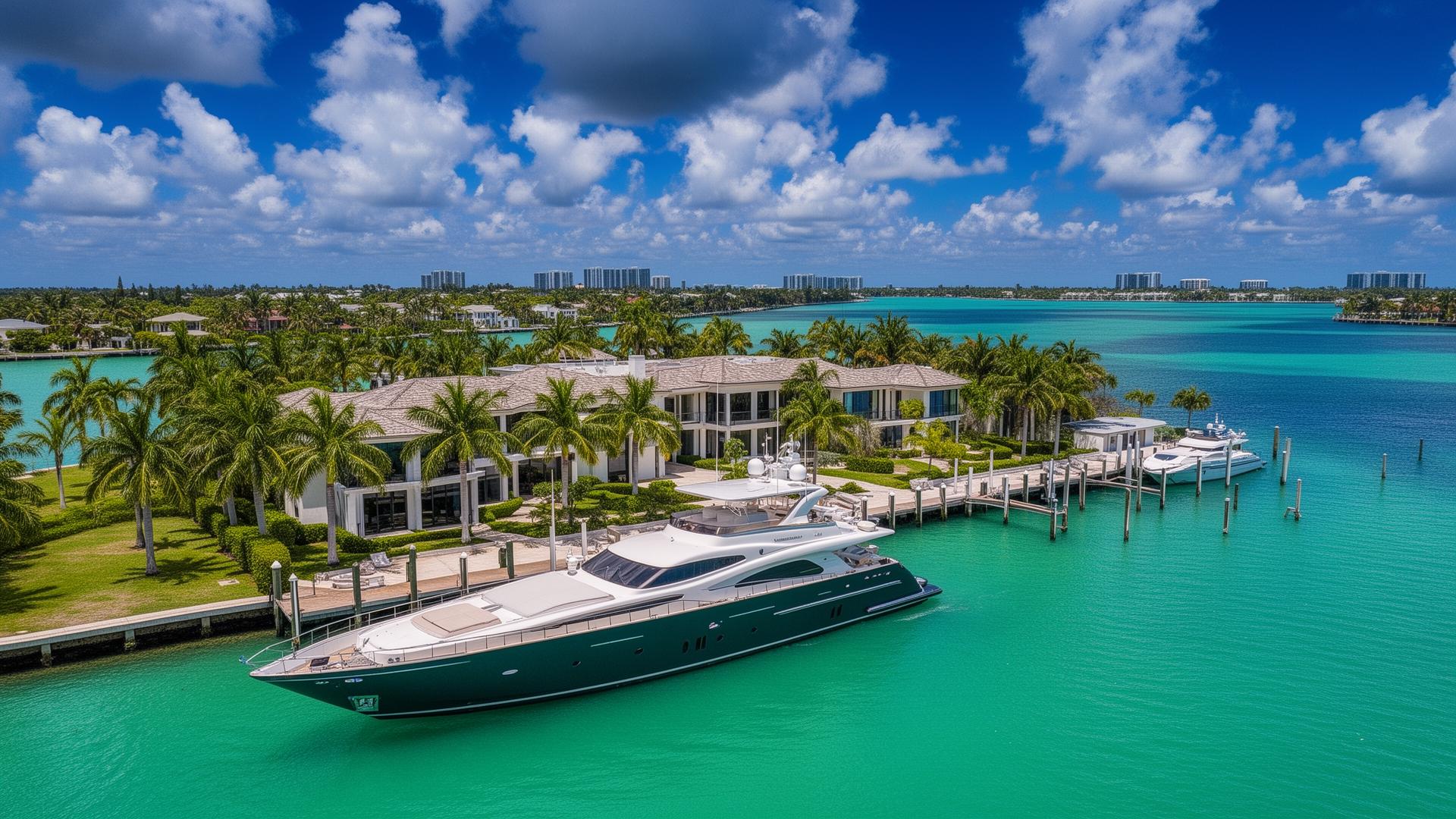
Seawall Inspection Guide for Miami Waterfront Buyers
Last updated: June 2026
A seawall inspection on a Miami waterfront property exists to answer one underwriting question: how much deferred capital are you buying along with the house. A full seawall replacement in South Florida commonly runs $300 to $1,200 per linear foot depending on material and site access, and a typical lot frontage of 75 to 100 feet can put a replacement in six figures [1][2]. Before you remove a financing or inspection contingency, you want a qualified marine contractor or engineer to evaluate the wall's elevation, its cap, the panel-to-cap connection, the tie-backs behind it, and any soil loss showing up as sinkholes or voids in the yard. You also want to know whether your jurisdiction will force an elevation upgrade when you renovate. In the City of Miami, new seawalls on tidally influenced waterfront east of US-1 (north of the Rickenbacker Causeway) must top out at 6.0 feet NAVD 88, and in Miami Beach new private seawalls must reach a minimum 5.7 feet NAVD [3][4]. Those rules can turn a cosmetic repair into a code-triggered rebuild. This guide covers what to inspect, what it costs, and how to price the risk into your offer.
Why the seawall is an underwriting line item, not a detail
On a waterfront purchase, the seawall is often the largest single structural component you cannot see clearly from the dock. It holds the upland soil in place, protects the foundation and pool deck, and in many Miami corridors is the difference between a property that stays dry during a king tide and one that does not. Unlike a roof, a failing seawall rarely announces itself with a leak. It shows up as a slow tilt, a widening cap crack, or soil quietly washing out behind the wall and into the bay.
Treat the inspection result as a number you can negotiate, not a pass/fail. A wall with 5 to 10 years of remaining life is a different deal than one with a cracked cap and visible voids, and both differ from a wall that already fails the current elevation code. The point of the inspection is to convert "the seawall looks fine" into a defensible repair-or-replace budget you can bring to the seller.
The seawall inspection checklist
Walk the wall at low tide if you can, and have your specialist document each of these. Photos and measurements matter more than impressions.
Cap and face condition
- Visible cracks, spalling, or exposed rebar on the concrete cap.
- Vertical cracks or bowing in the wall panels.
- Separation between the cap and the panels below it.
Movement and alignment
- Lean or tilt toward the water (sight down the cap line).
- Settlement or displacement between adjacent panels.
- Gaps at the corners or where the wall meets a neighbor's wall.
Soil and drainage signals
- Sinkholes, depressions, or soft spots in the yard near the wall.
- Tidal staining patterns that suggest overtopping or weep-hole failure.
- Erosion or undermining at the base, visible at low tide.
Materials, age, and tie-backs
- Material type (concrete, vinyl, steel, or older limestone/rock).
- Age and any permit or repair history on file with the city.
- Condition of tie-backs and deadmen, the buried anchors that keep the wall from rotating outward. These are among the costliest parts to replace because they sit behind the wall and under the yard.
For broader due-diligence sequencing on a coastal purchase, our buyer consultation walks through how the seawall inspection fits alongside the survey, elevation certificate, and insurance binder.
What a Miami seawall repair or replacement costs
As of June 2026, South Florida seawall pricing breaks down roughly as follows.
- Repairs typically run $100 to $250 per linear foot for routine work, with severe damage pushing toward $600 per linear foot. A typical residential repair job totals about $15,000 to $60,000 [1].
- Full replacement runs about $150 to $600 per linear foot by material, with vinyl at the low end ($150 to $300), steel in the middle ($200 to $400), and concrete at the top ($300 to $600) [1]. In the harder-access South Florida market, full replacement quotes commonly land in the $300 to $1,200 per linear foot range once permitting, water depth, and site access are factored in [2].
- Soft costs add up: permits and inspections often run $500 to $2,000, and difficult site access can add $2,000 to $5,000 [1].
Run the math on the actual frontage. A 90-foot wall at $500 per linear foot is roughly $45,000; the same wall in concrete at $900 per linear foot is closer to $81,000. That spread is exactly the negotiation you are trying to inform with the inspection. Costs vary widely with wall height, water depth, soil conditions, and permit complexity, so treat any per-foot figure as a planning range, not a quote.
Elevation rules can turn a repair into a rebuild
This is the part buyers miss. In several Miami-area jurisdictions, repairing or rebuilding a seawall, or doing substantial improvement to the home, can trigger a requirement to bring the wall up to current elevation standards.
- City of Miami: new seawalls on tidally influenced waterfront properties east of US-1 (other than those fronting the Miami River) must be set at a top elevation of 6.0 feet NAVD 88 north of the Rickenbacker Causeway [3].
- Miami Beach: all new private seawalls must reach a minimum 5.7 feet NAVD. For existing private seawalls being replaced or repaired without an associated new building, a minimum 4.0 feet NAVD applies, but the structural design must be able to accommodate a future extension to 5.7 feet NAVD [4].
The practical takeaway: a wall that is structurally tired and also below the required elevation may not be a candidate for a patch. If the work counts as substantial, you could be required to rebuild to code height, which changes the budget materially. Confirm the standard for the specific address and jurisdiction before you assume a low-cost repair is on the table.
Permitting and what touches the water is regulated
Seawall work in Florida is not a same-day project. The Florida Department of Environmental Protection (FDEP) regulates the construction of seawalls and other shoreline stabilization structures to protect water quality and adjacent property [5]. Key points for buyers underwriting a purchase:
- Some low-impact projects qualify for exemptions or general permits; larger or higher-impact work needs a standard individual permit, which can take several months to over a year [5].
- If the structure sits on state-owned submerged lands, you may need a separate Consent of Use from the state in addition to the permit [5].
- Rigid coastal armoring is governed by Florida Statute 161.085, and work waterward of the coastal construction control line requires a separate FDEP permit [5][6].
For a buyer, the timeline is the risk: if the wall needs replacement, you are not closing on a quick fix. You are inheriting a permitted construction project with a multi-month lead time, and the carrying cost of that should be reflected in the price or in a seller credit.
How to price the seawall into your offer
Underwrite it like any other deferred-maintenance item.
- Get the inspection in writing, with a repair-or-replace recommendation and a remaining-life estimate.
- Get at least one marine-contractor quote for the recommended scope, in linear feet, for the actual frontage.
- Check the elevation requirement for the address so you know whether a repair could escalate into a code-height rebuild.
- Negotiate the delta, either as a price reduction, a seller credit, or an escrow holdback for the work.
If you are comparing several waterfront options, this is also a useful way to rank them. Two homes at the same list price are not equivalent if one carries an $80,000 seawall liability and the other has a recently rebuilt wall with a transferable permit. You can browse current inventory among our Miami luxury homes for sale and bring the same lens to each.
Frequently asked questions
How much does a seawall cost to replace in Miami?
As of June 2026, full seawall replacement in South Florida commonly runs about $300 to $1,200 per linear foot depending on material, water depth, and site access, while material-by-material national ranges run roughly $150 to $600 per linear foot [1][2]. On a typical 75 to 100 foot lot, that often lands in the tens of thousands to low six figures.
Does a seawall need a permit in Florida?
Yes. The Florida Department of Environmental Protection regulates seawall construction and repair. Some low-impact work qualifies for exemptions or general permits, but larger projects require a standard permit that can take several months to over a year, and structures on state-owned submerged lands may need a separate Consent of Use [5].
What is the required seawall elevation in Miami?
It varies by jurisdiction. New seawalls on tidally influenced waterfront in the City of Miami (east of US-1, north of the Rickenbacker Causeway) must top out at 6.0 feet NAVD 88, and new private seawalls in Miami Beach must reach a minimum 5.7 feet NAVD [3][4]. Confirm the standard for the specific address.
Can a failing seawall affect my financing or insurance?
It can. Lenders and insurers may flag visible structural failure, and a wall that is below code elevation can complicate future renovation permits. Treat the inspection report and a contractor quote as part of your closing diligence, the same way you would a roof or foundation issue.
Who is responsible for the seawall, the owner or the city?
On private waterfront, the seawall is almost always the property owner's responsibility to maintain and replace, including bringing it to current code when substantial work is done [4]. Verify ownership and maintenance obligations in the title and survey before closing.
If you want a second set of eyes on a specific waterfront property, including a read on the seawall risk before you write an offer, reach out and we can walk the diligence together. I am happy to point you to qualified marine inspectors and help you price the wall into the deal.
Gabriel
Sources
- Helicon, Seawall Repair Cost Per Foot: 2026 Price Guide — https://heliconusa.com/seawall-repair-cost-per-foot/
- HomeGuide, 2026 Seawall Costs — Bulkhead & Seawall Costs Per Foot — https://homeguide.com/costs/seawall-cost
- City of Miami, Seawall Ordinance (top elevation 6.0 ft NAVD 88, tidally influenced waterfront) — https://www.miami.gov/files/sharedassets/public/v/1/news/2020/seawall-proposed-ordinance-change.pdf
- City of Miami Beach, Amended Seawall Ordinance 2025-4754 (5.7 ft NAVD new; 4.0 ft NAVD replacement with extension design) — https://www.mbrisingabove.com/wp-content/uploads/Ordinance-2025-4754-Amended-Seawall-Ordinance.pdf
- Florida DEP, Shoreline Stabilization permitting (seawalls, submerged lands, exemptions, CCCL) — https://floridadep.gov/sites/default/files/CRI_A_Homeowners_Guide_to_the_Living_Shoreline_Permit_Exemption_Part_1.pdf
- Florida Legislature, Statute 161.085 — Rigid coastal armoring structures — http://www.leg.state.fl.us/statutes/index.cfm?App_mode=Display_Statute&URL=0100-0199/0161/Sections/0161.085.html
Gabriel A. Moyers, PA. eXp Realty. Florida License #3407280. Equal Housing Opportunity. This article is general information as of June 2026 and is not legal, tax, or financial advice. Verify current seawall costs, permit requirements, and elevation standards with a licensed marine contractor, the Florida Department of Environmental Protection, and your local building department before acting.
Thinking of selling your luxury property in Miami? Find out what your home is worth.
Get Your Home ValuationLooking for your dream home in Miami? Take our personalized home search quiz.
Start Your Home Search Quiz