
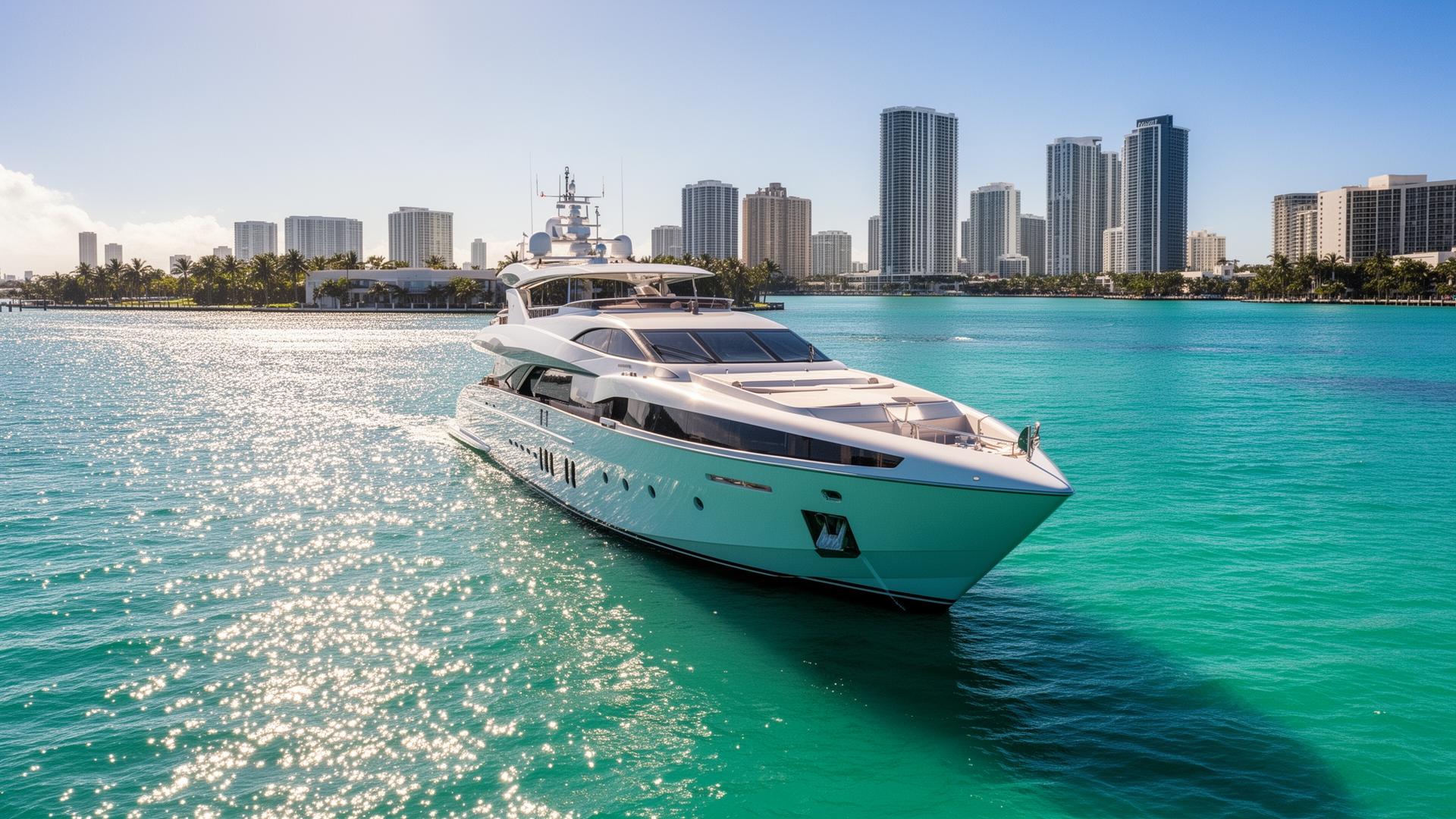
No Fixed Bridges in Miami: A Buyer's Guide to Direct Ocean Access
Last updated: June 2026
A Miami property with no fixed bridges is one where the route from your private dock to the Atlantic Ocean is not blocked by a low, permanently fixed bridge that caps how tall a vessel can pass. "Fixed" is the operative word. A drawbridge or bascule bridge opens on schedule and lets a tall mast through. A fixed bridge does not, so its lowest point sets a hard ceiling on your boat's air draft, the height of the tallest point above the waterline. If you run a sailboat with a tall mast or a motor yacht with a raised arch and antennas, a single fixed bridge between you and the inlet can decide what vessel you are able to keep at home.
This matters because Miami's two main ocean passes behave differently. Boats leaving the South Beach island chain can reach the Atlantic through Government Cut, a deep-water shipping channel with no overhead clearance limit. Boats north of the Julia Tuttle Causeway typically exit through Bakers Haulover Inlet, which is crossed by a fixed bridge with about 32 feet of vertical clearance [1]. That number, not the size of the house, is often what constrains a sailboat owner. The rest of this guide explains how to read a property's ocean access, which Miami areas tend to offer unobstructed routes, and the specific items to verify before you write an offer.
What "no fixed bridges" actually means
The phrase signals that nothing between the dock and open water permanently caps your air draft. There can still be opening bridges on the route, which is fine, because they raise to let taller vessels through. The problem is a fixed span. Its clearance is its clearance, every day, at every tide.
Air draft is measured to the highest fixed point on the boat: the masthead on a sailboat, or the top of the arch, hardtop, or antenna array on a motor yacht, with everything in its real cruising position [1]. A listing that advertises "no fixed bridges, direct ocean access" is making two claims at once. First, that the path out is unobstructed overhead. Second, that the path reaches the Atlantic without a detour through restricted water. Both are worth checking on a chart rather than taking at face value, because "direct ocean access" is used loosely across listings.
The two ocean passes that define Miami access
Where a property sits relative to Miami's inlets usually matters more than the neighborhood name.
Government Cut: no overhead ceiling
Government Cut is the manmade channel between South Beach and Fisher Island. It is the route that the Port of Miami uses, and the U.S. Army Corps of Engineers deepened it to 50 feet as part of the Miami Harbor deepening completed in September 2015 [2]. There is no fixed bridge across the cut, so there is no air-draft ceiling on the way out. For waterfront homes on or near the South Beach island chain, this is the meaningful detail. A tall sailboat or a large motor yacht can reach the Atlantic without waiting on a bridge or ducking under a fixed span.
Bakers Haulover Inlet: a 32-foot fixed ceiling
Bakers Haulover is the primary ocean pass for much of Miami's waterfront north of the Julia Tuttle Causeway. It is crossed by a fixed bridge with roughly 32 feet of vertical clearance and 125 feet of horizontal clearance [1]. That ceiling is permanent. A vessel whose air draft exceeds about 32 feet cannot use this inlet, regardless of tide. The inlet is also known for strong currents [1], which is a seamanship consideration rather than a real-estate one, but it belongs on the same checklist. If a property's only practical route to the ocean runs through Haulover, the 32-foot number is the constraint that defines the boat you can keep there.
Miami areas associated with unobstructed ocean access
These areas are commonly cited for direct or near-direct ocean access. Treat them as a starting point, not a guarantee, because access is set property by property, not by ZIP code.
- South Beach island chain (Star, Palm, Hibiscus, Venetian, and Sunset Islands). Homes here can route to the Atlantic through Government Cut, often reaching open water in roughly 10 to 15 minutes by boat, with no fixed-bridge ceiling on that path [3]. Dock depth and frontage still vary by home.
- Key Biscayne. Bayfront and oceanfront positions with quick access to the open Atlantic, subject to channel depth at the specific dock.
- Coconut Grove bayfront. Direct frontage on Biscayne Bay, where the route out depends on the chosen inlet and the boat's air draft.
- Coral Gables waterways. Canal and waterway frontage where the path to the bay can include bridges, so the no-fixed-bridge claim has to be checked on each canal.
Fair housing note: the comparison here is about water depth, bridge clearance, and routes to the ocean, not about who lives in any area. Buy the navigation, not the reputation.
How direct ocean access shows up in price
Waterfront commands a premium over comparable inland homes, and within waterfront, an unobstructed deep-water route to the ocean is part of what buyers in this segment pay for. To set the baseline, the Miami-Dade single-family median sale price was $670,000 in April 2026, down 1.47% from $680,000 a year earlier [4]. That is the whole county, where homes on water without ocean-grade access sit. True no-fixed-bridge, deep-water properties on the island chain and the prime bayfront trade well above that baseline, because the dock is doing real work: it is the difference between keeping a large vessel at home and keeping it at a marina across town.
For underwriting, that means the dock and the route are not amenities you tack onto the house value. They are a distinct asset. A buyer paying for ocean access should price the clearance, the depth, and the route the same way they price square footage, because those are the features a future buyer in this niche will also pay for. A house that looks comparable on paper but routes out through a 32-foot fixed bridge is not the same asset as one with a Government Cut path, even if the kitchens match.
What to verify before you make an offer
A "no fixed bridges" line in a listing is a claim to confirm, not a closing fact. Before you commit, check:
- The actual route to the ocean on a chart. Trace the path from the dock to the inlet and confirm there is no fixed span on it. If the route uses Haulover, you are capped near 32 feet of air draft [1].
- Your vessel's true air draft. Measure to the highest fixed point in cruising trim. Compare it against every bridge on the route, with margin.
- Water depth at the dock at low tide. Direct ocean access is only useful if your draft clears the bottom at your own seawall.
- Dock and seawall permits and condition. Confirm the dock dimensions, any vessel-length limits, and the seawall's condition and permitting, since these affect both use and resale.
- Bridge clearance figures against a current source. Clearances change with maintenance and rebuilds. Verify against the U.S. Coast Pilot or current navigation charts rather than older listing copy.
If you want a second set of eyes on the route before you tour, see the buyer consultation page or browse current Miami luxury homes for sale. Owners weighing what their dock and access add to value can start with a listing valuation.
Frequently asked questions
What does "no fixed bridges" mean for a Miami waterfront home? It means the route from the dock to the open ocean is not crossed by a low, permanently fixed bridge that caps your boat's air draft. Opening bridges may still be on the route, but they raise to let taller vessels through [1].
Why does air draft matter more than the size of the house? Air draft, the height of the tallest fixed point on your boat above the water, decides whether you clear the bridges on your route. A sailboat with a tall mast can be blocked by a fixed bridge that a single-story house sits next to, which is why route and clearance, not square footage, define what vessel you can keep at home [1].
Which Miami areas have direct ocean access without a fixed bridge? The South Beach island chain routes to the Atlantic through Government Cut, which has no fixed-bridge ceiling and was deepened to 50 feet in 2015 [2][3]. Key Biscayne and Coconut Grove bayfront also offer strong access, though the unobstructed claim should be confirmed property by property.
How tall a boat can pass through Bakers Haulover Inlet? The Haulover bridge is a fixed span with about 32 feet of vertical clearance, so vessels with more than roughly 32 feet of air draft cannot use that inlet at any tide [1].
Does direct ocean access add to a property's value? Waterfront trades above comparable inland homes, and within waterfront, deep-water access without a fixed-bridge ceiling is a distinct, priced feature. The Miami-Dade single-family median was $670,000 in April 2026 [4]; true no-fixed-bridge ocean-access homes generally sit well above that countywide figure.
Working through the access question
If you are buying for the boat as much as the house, the dock and the route deserve the same underwriting discipline as the structure. I am glad to chart the route to the ocean from a specific dock, pull the bridge clearances, and tell you honestly whether a listing's "direct ocean access" claim holds up before you spend a weekend touring. If that would help, reach out and we can look at it together.
Gabriel
Sources
- Waterway Guide and brokerage navigation explainers, Bakers Haulover Inlet bridge clearance and air-draft definition — https://www.waterwayguide.com/bridge/3-147/bakers-haulover-inlet-bridge
- U.S. Army Corps of Engineers, Jacksonville District, Miami Harbor Deepening (Deep Dredge to 50 feet, completed September 2015) — https://www.saj.usace.army.mil/Missions/Civil-Works/Navigation/Navigation-Projects/Miami-Harbor-Deepening/
- MILLION / brokerage island guides, Government Cut ocean access from the South Beach island chain — https://www.millionluxury.com/news/miami-beachs-star-island-vs-venetian-islands-ultra-exclusive-island-living-showdown
- MIAMI REALTORS, Miami-Dade single-family home median sale price, April 2026 — https://www.miamirealtors.com/2026/05/15/miami-dade-home-sales-rise-for-eighth-consecutive-month/
Gabriel A. Moyers, PA. eXp Realty. Florida License #3407280. Equal Housing Opportunity. This article is general information as of June 2026 and is not legal, tax, or financial advice. Verify current bridge clearances and channel depths against the U.S. Coast Pilot, NOAA navigation charts, and the U.S. Army Corps of Engineers before acting.
Thinking of selling your luxury property in Miami? Find out what your home is worth.
Get Your Home ValuationLooking for your dream home in Miami? Take our personalized home search quiz.
Start Your Home Search Quiz