
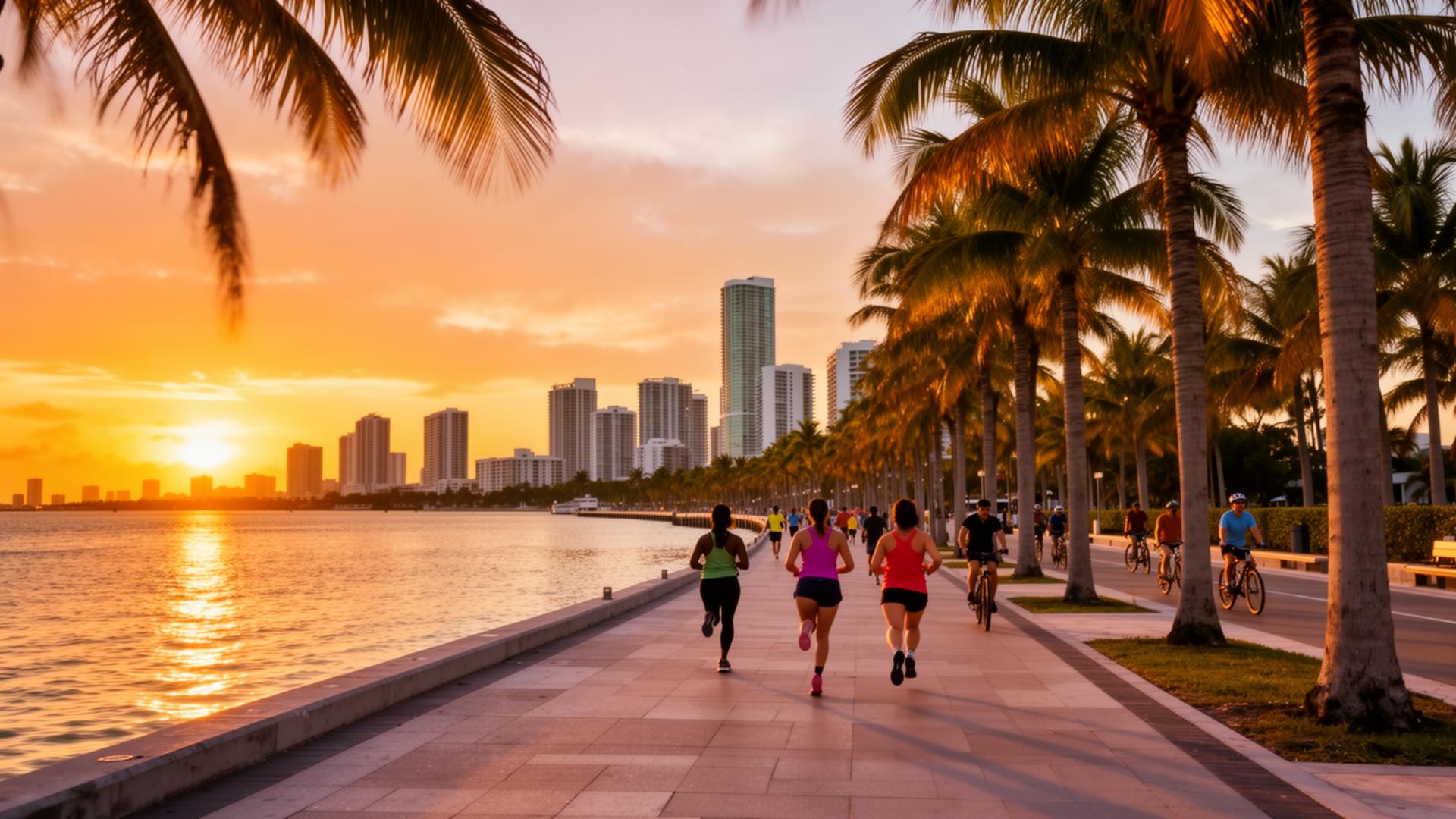
Miami Fitness Culture: Homes Near Best Gyms and Studios
Last updated: July 2026
If you want to buy where you can walk to a boutique studio, run a waterfront loop, and live in a building with a serious gym, a handful of Miami neighborhoods do the work for you. For Miami homes near gyms and walkable fitness access, Brickell, South Beach, Coconut Grove, and Coral Gables consistently pair dense studio clusters with running and biking infrastructure. Brickell and the surrounding urban core carry the highest walkability in the city, which is why you find Barry's, F45, Pilates, and cycling studios within a few blocks of each other there. Miami overall scores 77 on Walk Score, rated Very Walkable, while Downtown scores 91 [1].
The practical question for a buyer is not only which neighborhood has the studios, but whether the building itself carries a gym worth paying for, and what that amenity does to your monthly HOA. This piece walks through the neighborhoods that deliver walkable fitness, how to read building amenities as an underwriting item, and where the wellness premium is real versus where you are paying for a room you will not use.
What "fitness-forward" actually means when you buy
Active buyers tend to lump three different things together: proximity to independent studios, access to running and biking paths, and in-building fitness amenities. They price differently, so it helps to separate them.
Studio proximity is a location feature. It shows up in walkability and does not add to your carrying cost, because you pay the studio directly. Path access is a public-infrastructure feature tied to the neighborhood. In-building amenities are the line item that lands in your HOA, and they range from a token treadmill room to a full wellness floor with a spa, cold plunge, and a program of classes.
The wellness segment has grown enough that developers now treat these amenities as a pricing lever rather than a courtesy. The global wellness real estate market reached $584 billion in 2024 and is forecast to roughly double to $1.1 trillion by 2029 [2]. Mid- to high-end residential properties marketed on wellness features have been shown to command a price premium in the range of 10 to 25 percent [2]. That premium is not automatic, and part of your job as a buyer is deciding when it is backed by real, well-run facilities.
Neighborhoods that deliver walkable fitness access
Brickell and the urban core
Brickell is the clearest example of walkable fitness density in Miami. The concentration of boutique studios, national gym brands, and grocery is high enough that many residents do not drive to work out. The Brickell neighborhood also sits at the northern trailhead of The Underline, a linear park being built beneath the Metrorail that will run about 10 miles from Brickell to Dadeland when finished [3]. The Brickell Backyard segment is already open and gives residents a car-free path with exercise stations and a walking and biking corridor.
Buildings here lean into the trend. Newer condos market fitness centers, yoga studios, and spa floors as core amenities, which is part of why HOA figures in the newest towers run higher than in older stock. If you buy in Brickell primarily for walkability, you can often accept a more modest in-building gym and use the neighborhood studios instead.
South Beach and Miami Beach
Miami Beach pairs studio density with the obvious outdoor asset: the beach, the boardwalk, and Flamingo Park. The oceanfront path and the Beachwalk give runners and cyclists a continuous route, and South Beach carries a strong cluster of Pilates, cycling, and functional-training studios. The tradeoff is that a share of the housing stock is older, so in-building gyms vary widely. Underwrite the specific building, not the neighborhood reputation.
Coconut Grove
Coconut Grove is the choice for buyers who want tree canopy, bayfront paths, and a lower-intensity version of the studio scene. Kenneth Myers and the waterfront parks give you running loops with shade, and the Commodore Trail connects the Grove toward Coral Gables for cyclists. Newer Grove condos have brought stronger wellness amenities into an area that historically ran on independent studios and outdoor activity.
Coral Gables
Coral Gables skews toward single-family and low-rise living, so the fitness story is less about tower amenities and more about walkable and bikeable streets, the Venetian Pool, and proximity to studios along Miracle Mile and the surrounding commercial corridors. Buyers here often prioritize a private home gym or a nearby membership over a shared building facility.
Running and biking infrastructure to check before you buy
Studios come and go, but public paths are durable, and they tend to hold value for active buyers. Three assets are worth mapping against any address you consider:
- The Underline. The Brickell-to-Dadeland linear park adds a protected running and biking corridor along the Metrorail spine [3]. Proximity to an open segment is a genuine locational feature.
- The Miami Beach Beachwalk and boardwalk. A continuous oceanfront path that supports running, walking, and cycling across South Beach and beyond.
- The Rickenbacker Causeway and Key Biscayne. A well-known cycling and running route out to Key Biscayne, with beach access and park loops at the end.
When you tour, put the address on a map with these paths and the nearest studios. A short, safe walking route matters more than the raw number of gyms in the ZIP code.
How wellness amenities affect condo value and HOA
This is where fitness-forward buying meets underwriting. A strong wellness floor can support resale value, but it also raises your monthly cost and your exposure to special assessments, because pools, spas, saunas, and cold plunges are maintenance-heavy.
Work through these questions on any building with a marketed wellness program:
- What share of the HOA funds the amenity? Ask the association for the budget. A large fitness and spa floor can be a meaningful part of the monthly figure. Decide whether you will use it enough to justify that share.
- Is the amenity staffed or self-service? Programmed classes and staffed spas cost more and can carry usage fees on top of the HOA. A self-service gym is cheaper to run.
- How old are the systems? Saunas, pool equipment, and HVAC for a wellness floor age, and replacements often arrive as special assessments. Review reserves and recent assessment history.
- Does the premium hold on resale? Wellness amenities support pricing when they are well maintained and genuinely differentiated. A dated gym in a building with deferred maintenance does the opposite.
The wellness premium documented in the market data is a starting point, not a guarantee for a specific unit [2]. A well-run building with a real program can defend that premium. A building that added a token gym to its marketing generally cannot.\n\n## A simple way to weigh it
Decide which of the three fitness features you actually value, then match the neighborhood and building to it. If you want walkable studios and are happy to pay the studio directly, prioritize a walkable neighborhood like Brickell and accept a lighter in-building gym to keep the HOA down. If you want everything under one roof, underwrite the wellness floor as carefully as you would the roof or the elevators, because you are paying for it every month. If you mainly want to run and ride, buy near a durable public path and treat the gym as secondary.
If you want a read on how a specific building's amenities and HOA compare to nearby alternatives, a buyer consultation is the right place to work through it against your budget and how you actually train.
Frequently asked questions
Which Miami neighborhood is best for walking to gyms and studios?
Brickell and the surrounding urban core have the highest studio density and walkability, which is why boutique brands cluster there. Miami overall is rated Very Walkable at 77 on Walk Score, and Downtown scores 91 [1]. South Beach is the strongest alternative if you also want an oceanfront path.
Do condo wellness amenities actually add resale value?
Market data shows mid- to high-end wellness-focused residential properties can command a 10 to 25 percent premium [2]. That premium depends on the amenity being genuinely differentiated and well maintained. A dated or under-reserved facility can weigh on value rather than support it, so review the specific building.
How much can a wellness floor add to my HOA?
It varies by building, and there is no fixed figure. Staffed spas, pools, saunas, and cold plunges are maintenance-heavy and can be a meaningful part of the monthly HOA, plus a source of special assessments as equipment ages. Ask the association for the budget and recent assessment history before you commit.
Is there good running and biking infrastructure in Miami?
Yes. The Underline is a linear park being built beneath the Metrorail that will run about 10 miles from Brickell to Dadeland, with the Brickell segment already open [3]. The Miami Beach Beachwalk and the Rickenbacker Causeway toward Key Biscayne are two more durable, well-used routes.
Should I prioritize the building gym or the neighborhood?
It depends on how you train. If you prefer boutique classes, prioritize a walkable neighborhood and keep your HOA lower with a lighter building gym. If you want to train at home, underwrite the building's wellness amenities and reserves carefully, since you pay for them monthly.
Gabriel
Sources
- Walk Score, Living in Miami
- Global Wellness Institute, Build Well to Live Well: The Future (2025 wellness real estate market data)
- Miami-Dade County, The Underline
Gabriel A. Moyers, PA. eXp Realty. Florida License #3407280. Equal Housing Opportunity. This article is general information as of July 2026 and is not legal, tax, or financial advice. Verify current figures against authoritative sources before acting.
Thinking of selling your luxury property in Miami? Find out what your home is worth.
Get Your Home ValuationLooking for your dream home in Miami? Take our personalized home search quiz.
Start Your Home Search Quiz