
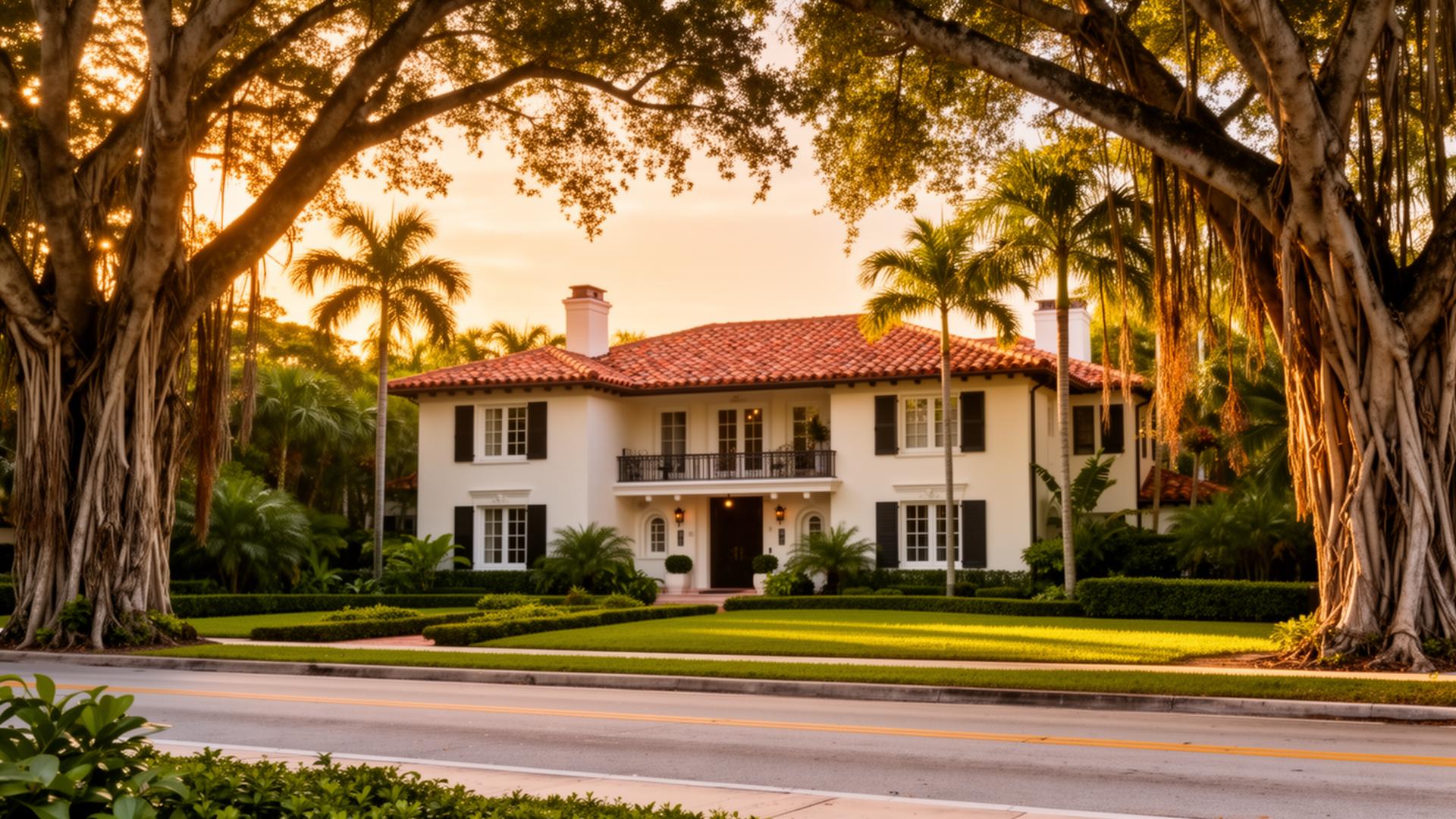
Coral Gables Historic Homes: A Buyer's Complete Guide
Last updated: July 2026
Buying a historic home in Coral Gables is a different transaction from buying an ordinary house, and the differences cut both ways. On one side, a locally designated property comes with real restrictions: exterior work requires a Certificate of Appropriateness from the city's Historic Preservation Board, and essentially all exterior changes in the city pass through the Board of Architects. On the other side, Coral Gables offers a genuine financial offset that most buyers have never heard of: a historic preservation ad valorem tax exemption that freezes the assessed value attributable to qualifying improvements at the pre-renovation level for ten years [1]. The stock itself is the draw. The city holds more than 1,200 properties listed as Local Historic Landmarks in the Coral Gables Register of Historic Places [2], much of it 1920s Mediterranean Revival built under George Merrick's original City Beautiful plan. Zillow puts the typical Coral Gables home value at roughly $1.34 million in 2026 [3], with historic estates trading across a wide range around that figure. This guide covers what designation actually means, how approvals work, the tax exemption, and the insurance realities of Coral Gables historic homes.
The stock: Merrick-era Mediterranean Revival
Coral Gables was planned and largely built out in the 1920s as one of the country's first fully designed communities. Merrick's development produced the Mediterranean Revival vocabulary the city still enforces: barrel tile roofs, stucco over masonry, coral rock details, arched loggias, and courtyard plans. The city's own preservation guide is explicit that protecting this fabric is a municipal priority, administered through the Historical Resources Department and a nine-member Historic Preservation Board with quasi-judicial authority [2].
For a buyer, the practical categories are: individually designated landmarks, contributing properties within local historic districts, and older homes that are not designated but could become eligible. Which category a house falls into determines your renovation path, so establish it before you write an offer, not after. The Historical Resources Department can confirm a property's status.
What historic designation actually means
Under the city's criteria, a property generally must be at least 50 years old to qualify, and it must have historical, cultural, aesthetic, or architectural significance, for example association with significant events or persons, or architectural distinction typical of Merrick-era work [2]. Designation can be initiated by the owner or by others; the Historic Preservation Board holds a public hearing and votes on listing in the Coral Gables Register.
Designation is recorded against the property and binds future owners. The core consequence: a Certificate of Appropriateness (COA) is required before the city issues permits for most exterior work on a designated or contributing property, including additions, window and door changes, roof replacement, and any demolition, partial or total [2][4]. Reviews follow preservation standards, so the question is never just whether the work is code compliant but whether it is appropriate to the structure.
Renovation approvals: COA plus the Board of Architects
Two review tracks matter in Coral Gables, and buyers routinely confuse them.
The Historic Preservation Board / Historical Resources Department handles Certificates of Appropriateness for designated properties, as described above.
The Board of Architects reviews essentially all exterior alterations and new construction citywide, historic or not, against the design review standards in the city's zoning code, covering compatibility of color, materials, fenestration, and proportion [4]. Even a non-designated 1950s ranch in the Gables goes through this review for exterior changes.
Underwrite the timeline accordingly. Plan on multiple review cycles for significant projects, and sequence your contractor, architect, and financing around approvals rather than assuming a permit follows a purchase in a straight line. If you are comparing a designated home against a non-designated one, price the difference in approval friction, not just the difference in list price.
The tax offset: Coral Gables' ad valorem exemption
Florida law (Sections 196.1997 and 196.1998, Florida Statutes) authorizes local governments to grant property tax exemptions for qualifying improvements to historic properties, and Coral Gables has adopted the program [1]. The mechanics matter:
- The exemption applies to the increase in assessed value attributable to the qualifying restoration or renovation work, not to the whole property's tax bill [1].
- That improvement-related increase is exempted for ten years [1].
- The work must be pre-approved: the application requires before photographs, plans, the approved COA, and proof of designation, reviewed through the city's preservation office before construction [1].
Read that as an underwriting input. If you are buying a designated home that needs a significant renovation, the exemption means the taxable value bump from that renovation can be deferred for a decade, which materially changes the carrying cost math versus doing identical work on a non-historic house. It is not a discount on the purchase; it is a subsidy on the improvement. Sequence the paperwork before construction starts, because retroactive approval is not the design of the program.
Insurance and the roof question
Most Coral Gables historic homes are 75 to 100 years old, and insurers underwrite them accordingly. Expect a four-point style review of roof, electrical, plumbing, and HVAC, and expect the roof to drive the conversation.
Florida law gives owners some protection here. Under Section 627.7011, Florida Statutes, an insurer cannot refuse to write or renew a homeowners policy solely because of roof age when the roof is less than 15 years old, and for roofs 15 years or older the owner may obtain an inspection by an authorized inspector; if it shows at least five years of remaining useful life, the insurer cannot refuse coverage solely on roof age [5].
The historic wrinkle: replacing a barrel tile roof on a designated home requires a COA [2], and matching historic tile is slower and costlier than a standard reroof. If an insurer gives you a roof-replacement timeline as a condition of coverage, that clock and the preservation approval clock need to be reconciled before closing. Ask for the roof's permit history and any prior inspection reports during due diligence, and get a bindable insurance quote inside your inspection period.
Underwriting the purchase
Pricing context first: Zillow's typical Coral Gables home value sits around $1.34 million in 2026, roughly flat against the prior year [3], and marketing times in the city have lengthened, which favors disciplined buyers. Against that backdrop, a historic purchase checklist looks like:
- Confirm designation status and pull the property's COA history with the Historical Resources Department.
- Scope inspections for age: electrical, plumbing, foundation, and roof, with contractors who know pre-war masonry construction.
- Model the renovation with Board of Architects and COA cycles in the schedule [4].
- Apply for the ad valorem exemption before qualifying work begins [1].
- Comp against other historic sales, not against new construction. The Coral Gables market page covers the broader neighborhood picture.
If you are weighing a specific designated property, bring it to a buyer consultation and we can pressure-test the renovation and carrying-cost assumptions. Owners of designated homes thinking about the other side of the trade can start with a valuation of the property.
Frequently asked questions
Can I demolish or significantly alter a designated historic home in Coral Gables? Not without city approval. Demolition, partial or total, and most exterior alterations on a designated property require a Certificate of Appropriateness from the Historic Preservation Board before permits are issued [2].
Does historic designation hurt resale value? It restricts what future owners can change, which narrows the buyer pool for some properties and deepens it for others, since designated districts carry cachet in the Gables. There is no honest one-line answer; comp the specific street and property type.
How do I find out if a house is designated? Ask the city's Historical Resources and Cultural Arts Department, which maintains the Coral Gables Register of more than 1,200 listed landmarks [2]. Do this during due diligence, not after closing.
Can I install impact windows in a historic home? Generally yes, with a COA. Reviews focus on profiles and materials consistent with the home's character, and manufacturers now make impact products designed for historic openings [4].
Is the tax exemption automatic once a home is designated? No. It applies only to pre-approved qualifying improvements, requires an application with plans and photographs before work begins, and runs for ten years on the improvement value [1].
Gabriel
Sources
- City of Coral Gables, Historic Preservation Ad Valorem Tax Exemption Program application and instructions
- City of Coral Gables, Preserving Our Past: A Guide to Historic Preservation in Coral Gables
- Zillow, Coral Gables FL Home Values (2026)
- City of Coral Gables, Board of Architects
- Florida Statutes 627.7011, Homeowners' policies; offer of replacement cost coverage and law and ordinance coverage
Gabriel A. Moyers, PA. eXp Realty. Florida License #3407280. Equal Housing Opportunity. This article is general information as of July 2026 and is not legal, tax, or financial advice. Verify current figures against authoritative sources before acting.
Thinking of selling your luxury property in Miami? Find out what your home is worth.
Get Your Home ValuationLooking for your dream home in Miami? Take our personalized home search quiz.
Start Your Home Search Quiz