
Foreign Buyers in Miami: 2026 Investment Trends
Last updated: July 2026
Miami is once again the number one U.S. market for foreign homebuyers. According to the MIAMI REALTORS international report released in January 2026, foreign buyers purchased $4.4 billion of South Florida residential real estate in 2025, up from $3.1 billion the year before, and international buyers accounted for 15 percent of the region's dollar volume, roughly seven times the 2 percent U.S. average [1]. Colombia and Argentina were the top origin countries, and 51 percent of international transactions closed in cash [1]. Miami-Dade County alone absorbed $3.2 billion of that volume [1].
If you are evaluating foreign buyers Miami real estate trends for 2026, three facts matter most: the capital flow is growing again, it concentrates heavily in condos and new construction, and the tax mechanics on the exit (FIRPTA withholding) are predictable if you plan for them. This article walks through the sourced numbers and what they mean for underwriting a purchase or a sale here.
Miami's position in the national picture
The National Association of REALTORS counted $56 billion in U.S. existing-home purchases by international buyers from April 2024 through March 2025, a 33.2 percent increase over the prior period and the first year-over-year gain since 2017 [2]. Foreign buyers closed on 78,100 U.S. properties in that window, and 47 percent paid cash, compared with 28 percent of all buyers [2].
Florida captured 21 percent of all international purchases nationally, ahead of California at 15 percent and Texas at 10 percent, extending a streak as the top state that has run for at least 15 years [2]. Within that, South Florida alone represents roughly 10 percent of all international home sales in the country [1]. No other U.S. metro concentrates global residential capital the way this one does.
Where the capital comes from
The 2025 origin mix, per MIAMI REALTORS [1]:
- Colombia: 15 percent of South Florida international purchases
- Argentina: 12 percent
- Mexico and Brazil: 7 percent each
- Venezuela, Canada, and Peru: roughly 5 percent each
- Spain and Chile: about 4 percent each
- Italy: about 3 percent
Colombia and Argentina together accounted for 27 percent of international closed sales in the region [1]. The pattern is consistent with what drives this market cycle after cycle: capital preservation demand from Latin America layered over lifestyle and investment purchases from Canada and Europe.
Pricing follows the capital. International buyers in South Florida paid a median of $558,700 in 2025, about 13 percent above the $494,400 national median for foreign buyers [1][2]. Buyers from Mexico recorded the highest median purchase price at $934,000 [1].
What international buyers actually purchase
Condominiums took 51 percent of South Florida international purchases, versus about 15 percent for foreign buyers nationally [1]. Nearly half of recent international purchases were new construction, and 63 percent of buyers chose central or urban locations [1].
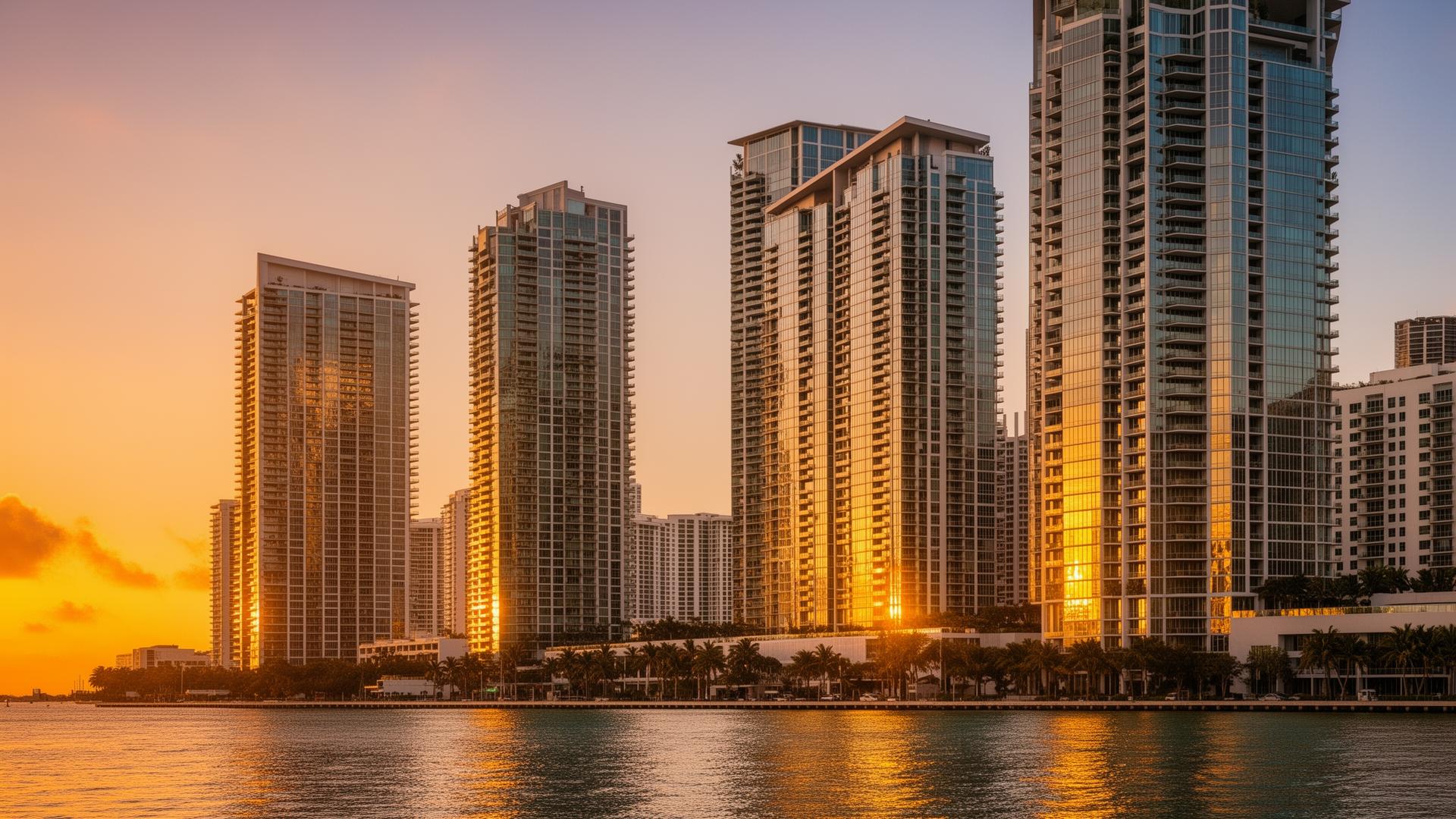
That profile maps directly onto neighborhoods like Brickell, where new towers, walkability, and rental demand line up with how international capital wants to hold Miami real estate: lock-and-leave, professionally managed, and lettable when the owner is abroad.
For underwriting purposes, this matters in two directions. If you are buying resale condo product in an internationally favored submarket, your future exit buyer may well be a cash purchaser from abroad, which supports liquidity. If you are competing to buy, you should expect a meaningful share of rival offers to be cash with fast timelines.
Why the allocation keeps coming back
The structural case has not changed much, and it does not depend on any single year's numbers:
- A Miami property is a dollar-denominated hard asset, which is precisely the point for buyers hedging home-country currency and political risk.
- Florida levies no state personal income tax [3], which affects the math for owners who establish residency or hold income-producing property here.
- Flight connectivity and time-zone alignment with Latin America make Miami practical for owners who split time between countries.
- The market is deep. Thousands of international closings a year mean a foreign owner is rarely stuck without a buyer pool.
FIRPTA basics for foreign sellers
The Foreign Investment in Real Property Tax Act (FIRPTA) is the piece most foreign owners underestimate. When a foreign person sells U.S. real property, the buyer is generally required to withhold 15 percent of the gross amount realized, essentially the sales price, and remit it to the IRS with Forms 8288 and 8288-A within 20 days of closing [4].
Key points from the IRS rules [4]:
- The rate can drop to 10 percent when the buyer will use the property as a residence and the price does not exceed $1,000,000.
- Withholding can be avoided entirely when the buyer will use the property as a residence and the price is $300,000 or less.
- The withholding is a prepayment, not the final tax. The seller files a U.S. tax return, and the actual capital gains tax owed is reconciled against the amount withheld, which often produces a refund.
- A withholding certificate application can reduce the amount held at closing when the expected tax is lower than the standard withholding.
The practical takeaway: FIRPTA is a cash-flow event, not a penalty, but it needs to be planned at the listing stage, not discovered at the closing table. If you are a foreign owner thinking about an exit, start with a realistic view of what the property is worth today through a professional valuation, then have your tax advisor model the withholding and reconciliation before you price the sale.
What this means if you are buying or selling in 2026
For sellers of condo product in urban submarkets, the international pool is a real demand channel again, with dollar volume up 42 percent year over year in 2025 [1]. Marketing that ignores it leaves buyers on the table.
For domestic buyers, the cash-heavy competition concentrates in specific product types: new and near-new condos in central locations. Single-family product in interior neighborhoods sees far less of it. Structuring an offer to compete with cash, through strong escrow terms, tight contingency windows, and underwritten pre-approval, is a solvable problem, and it is exactly the kind of thing to work through in a buyer consultation before you are up against a deadline.
Frequently asked questions
What share of Miami home sales go to foreign buyers?
International buyers accounted for 15 percent of South Florida residential dollar volume in 2025, versus about 2 percent nationally, per MIAMI REALTORS [1]. The share is higher in urban condo submarkets and lower in suburban single-family neighborhoods.
Which countries buy the most Miami real estate?
Colombia led in 2025 at 15 percent of international purchases, followed by Argentina at 12 percent, with Mexico, Brazil, Venezuela, Canada, and Peru rounding out the top tier [1].
Do foreign buyers pay cash?
Slightly more than half do. 51 percent of South Florida international transactions in 2025 were all cash [1], compared with 47 percent of foreign-buyer purchases nationally [2].
What is FIRPTA and who pays it?
FIRPTA requires the buyer to withhold, generally, 15 percent of the sales price when purchasing U.S. real property from a foreign seller and remit it to the IRS [4]. Economically it comes out of the seller's proceeds and is credited against the seller's actual U.S. tax liability when they file a return.
Can a foreign national get a U.S. mortgage?
Yes. Several lenders offer foreign-national loan programs, typically with larger down payments and reserve requirements than conforming loans. Even so, a majority of international purchases in this market close in cash [1].
Gabriel
Sources
- Miami is #1 U.S. Market for Foreign Home Buyers, MIAMI REALTORS (PR Newswire, January 2026)
- International Buyers Purchased $56 Billion Worth of U.S. Homes from April '24 to March '25, National Association of REALTORS (July 2025)
- Florida Tax Rates and Rankings, Tax Foundation
- FIRPTA Withholding, Internal Revenue Service
- MIAMI REALTORS 2026 International Report announcement (January 27, 2026)
Gabriel A. Moyers, PA. eXp Realty. Florida License #3407280. Equal Housing Opportunity. This article is general information as of July 2026 and is not legal, tax, or financial advice. Verify current figures against authoritative sources before acting.
Thinking of selling your luxury property in Miami? Find out what your home is worth.
Get Your Home ValuationLooking for your dream home in Miami? Take our personalized home search quiz.
Start Your Home Search Quiz